Did you know KiwiRPG has a mailing list? It’s for KiwiRPG week, giving you reminders, pointing out the best stuff, sharing a few secrets, and then going into hibernation until the next KiwiRPG week.

You should sign up!  

We’ve just sent out our final email for this year’s KiwiRPG week, and it seems like a good idea to include some of the urgent items right here. CUT AND PASTE POWERS ACTIVATE:


URGENT ITEMS!

Hurry! Hurry! The clock is tickling! 

  • VOTE! The CRIT Awards have nominated Gothhoblin’s Thus Spake Agathis (Trophy Dark) for “Best Homebrew, Supplement, or Third Party Content”. Find the voting form is linked on the CRIT Awards website https://www.critawards.org/; Gothhoblin has made a bunch of community copies available if you want to check it out. “Thus Spake Agathis is inspired by the near total decimation of the Kauri forests in New Zealand as a result of European colonisation in the 18th and 19th centuries, along with the Kauri tree’s profound place in Māori mythology as connected to the spiritual realm.”
  • One week to go on the Bloodthirst crowdfund! Bloodthirst is a fast-paced vampire roleplaying game built on Gila RPGs’ LUMEN system. Find it on Backerkit here.
  • And this kickstarter is launching soon: Sage Council, a comedic story game about being the city council in a fantasy town!


END CUT AND PASTE SECTION! See? Good stuff in there! 

(This has been an attempt to encourage signups to the KiwiRPG week email list. Did it work?)


Huge news for KiwiRPG creators on DriveThruRPG: our friends there have set up a KiwiRPG week filter that digs out all the KiwiRPG titles! So cool!

BUT WAIT!

THERE’S MORE!

This means we can do really cool stuff like this: hey DriveThru, show me all the KiwiRPG titles that are included in the Christmas in July sale on right now!

We are so grateful to the team at DriveThru/Roll20 for setting this up!

The words ‘how to make tables that don’t suck’ in white on a beige background, with a painted old man with a pipe sawing wood, with dice, a DM screen, and an Earth Tongue poster behind him.

Kia ora, I’m Eamonn, sometimes known as Mōmoke, you can find some of my games here: https://momoke.itch.io/


How to build an encounter table that doesn’t suck (hopefully)

Or at least, how I built mine for my current campaign, and some of the lessons I learnt along the way.


The game:

The year is this one. The place is also this one, with some key differences.


In 2019, aliens came to earth in three locations: the Peruvian Coast, the bays of Sri Lanka, and the Coromandel. The visitors stayed here for three months, then seemingly left. Everything within a 60km radius of their landing was changed. The players are hobbyists—not experts—travelling to the Coromandel Visitation Zone, looting it for artifacts, and trying to get rich.


While there’s a lot of Zone fiction out there, and quite a few TTRPGs focused on it. None of them felt like a great fit for what I wanted. All were too in debt to Roadside Picnic, Stalker, or Annhiliation. They felt too American, or Russian, for my sensibilities. We decided on Liminal Horror, because of it’s modularity.


I wanted a game that felt local and leant into the strengths of that. We knew the territory and so we could really get into the nitty gritty of overland travel. In terms of prep, most of the land was already there; I just needed to fill it with things.


The random tables:

I wanted to use random tables for a few reasons: 1, I hadn’t before; 2, I had a good grasp of the location and key landmarks; 3, my previous campaign had been very planned out, and while my players had fun, I felt like they didn’t get a lot of opportunities to drive the story. I wanted a game where I was a passive adjudicator, helping them chase down a narrative.


I could have grabbed some random tables from another system, swap out some fo the monsters for my own, and call it done. But it would feel like a betrayal to that premise. What if a place we all knew well was populated by knock-off D&D creatures? I wanted to dive into the weirdness of Aotearoa.


The first table:

My first set of tables was based on Moose’s wonderful Tunnelers Campaign.  (https://icbmoose.blot.im/tagged/tunnelers). I would roll encounters in advance to give myself time to think about how to make them more than just a few statblocks in a spot. I planned around each day of travel having two encounters.


I made a d12 table where I would roll 1d4 and 1d12 and these would be that days encounters. Entries 1-4 were more common, mundane encounters, if a little generic.

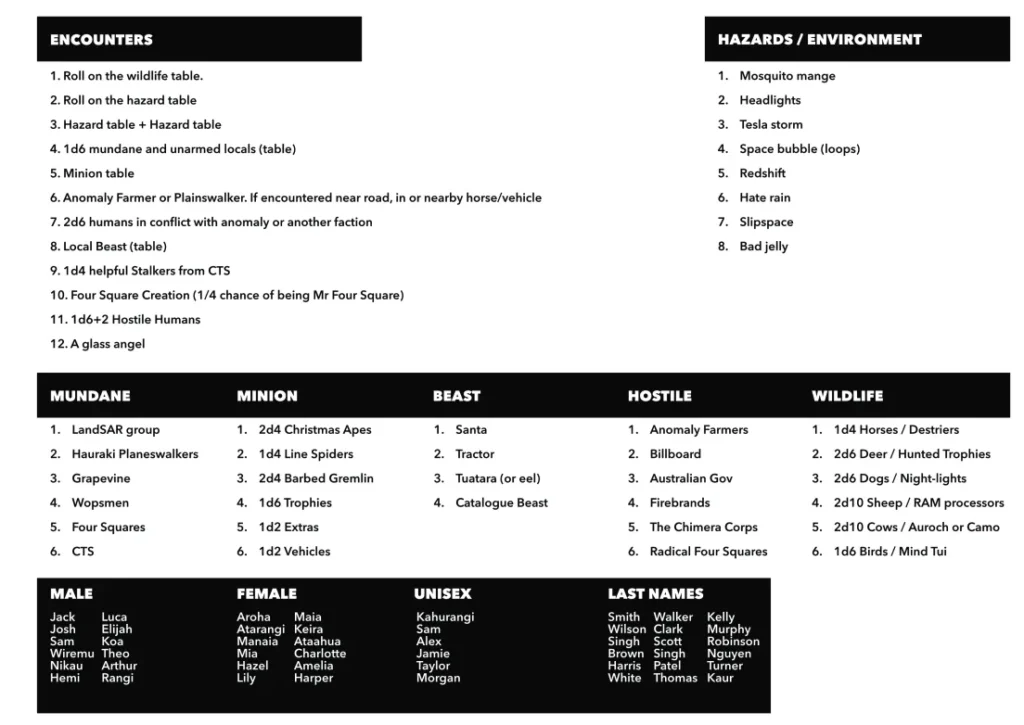
A series of tables with the headings ‘encounters’, ‘hazards/environment’, and ‘mundane, minion, beast, hostile, wildlife’. Below is a table of names, with the headings male, female, unisex, and last names.

Encounters:
1.	Roll on the wildlife table
2.	Roll on the hazard table
3.	Hazard table + hazard table
4.	1d6 mundane and unarmed locals (table)
5.	Minion table
6.	Anomly farmer or Plainswalker. If encountered near road or in nearby horse/vehicle
7.	2d6 humans in conflict with anomaly or another faction
8.	Local beast (table)
9.	1d4 helpful Stalkers from CTS
10.	Four square Creation (¼ chance of being Mr Four Square)
11.	1d6+2 Hostile Humans
12.	A glass angel

Hazards/environment
1.	Mosquito mange
2.	Headlights
3.	Tesla storm
4.	Space bubble (loops)
5.	Redshift
6.	Hate rain
7.	Slipspace
8.	Bad jelly

Mundane
1.	LandSAR group
2.	Hauraki planeswalkers
3.	Grapevine
4.	Wopsmen
5.	Four Squares
6.	CTS

Minion
1.	2d4 christmas apes
2.	1d4 line spiders
3.	2d4 barbed gremlin
4.	1d6 trophies
5.	1d2 extras
6.	1d2 vehicles

Beast
1.	Santa
2.	Tractor
3.	Tuatara (or eel)
4.	Catalogue beast

Hostile
1.	Anomaly farmers
2.	Billboard
3.	Australian gov
4.	Firebrans
5.	The chimera corps
6.	Radical four squares

Widlife
1.	1d4 horses/ destriers
2.	2d6 deer / hunted trophies
3.	2d6 dogs / night-lights
4.	2d10 sheep / RAM processors
5.	2d10 cows / auroch or Camo
6.	1d6 birds / mind tui

Male
Jack
Josh
Sam
Wiremu
Nikau
Hemi
Luca
Elija
Koa
Theo
Arthur
Rangi

Female
Aroha
Atarangi
Manaia
Mia
Hazel
Lily
Maia
Keira
Ataahua
Charlotte
Amelia
Harper

Unisex
Kahurangi
Sam
Alex
Jamie
Taylor
Morgan

Last names
Smith
Wilson
Singh
Brown
Harris
White
Walker
Clark
Scott
Singh
Patel
Thomas
Kelly
Murphy
Robinson
Nguyen
Turner
Kaur


(Yes, all these terms are meaningless, but they’re meaningful to me).


There were a few problems with this original table, which I noticed in play. This version of the table trended heavily towards the “normal”. Even though Hazards were still extremely common on this table, they weren’t showing up enough to feel like a Roadside picnic.


This table also required a LOT of rolling. Roll for the encounter table, roll the encounter table, roll the creatures in the encounter. Not only that, these were also rolls that I was often fudging. I had laid out the map with some dominant factions focused on certain areas. Which meant that certain outcomes just didn’t make sense in those areas.


Diagnosis:

I had designed these tables with the “best” options in mind. That each day would be a mix of different kinds of encounters. I hadn’t considered chance can be cruel. There were combinations of encounters that just weren’t interesting. (In my opinion, entries 1, 2, 4, and 9. Nearly half the entries here, three of which were more like to show up). Or, there was a chance that I’d roll the same (or similar) encounters again and again.


The biggeset problem was that these encounters, as the kids say, were cooked. Even with time to consider the situation and build them out, these encounters didn’t force players to do anything. The hazards, while interesting, weren’t strong enough to hold an encounter on their own. They were roadbumps, not challenges that made the players feel smart for overcoming them.


My next attempt at the table had some new, clearer goals:

  • Every entry on a table should do They should be a powder keg waiting to blow. They should be a fascinating problem to contend with, and avoiding or engaging them should have consequences.
  • Those entries should reflect how much something shows up in play. I shouldn’t hide essential, or exciting information behind them. If it was absolutely essential, it should be part of the core mechanics.  
  • Every encounter should be able to withstand bad luck. Figure out the most boring combinations and give them edges. Add details and teeth. Each encounter should feel like a microcosm of the entire campaign’s vibe.
  • Encounters should be trying to get something from the players, they should demand attention and recognition.


Following from that, here were the changes I made to both my game, and the random encounter table.


First, hazard rolls. Every time players travelled to another hex they roll 1d6. On the outskirts of the Zone there’s a 1/6 chance of a hazard being encountered. This goes up the closer they you are to the centre, capping out at a 3/6 chance. These odds can be furhter modified by other factors like travel speed.


Hazards are still random, but they’re way more common. They’re more like seasoning on other encounters. They’re a way to add energy into a situation. If you wanted to adapt them into another game this is where you could use weather or other effects to spice up a situation.


Second, daily effects. I wanted the centre of the Zone to feel more chaotic and I wanted to encourage a sort of “playground behaviour”. So I created an additional table that the players roll every morning. These are things that push everyone off balance (including me), creating both problems and opportunities.


Finally, better encounters. Instead of lower values being “normal” (boring) encounters, they instead reflected the default amount of threat that encounter brought with it. These encounters aren’t my final design, but they’re a start in the right direction. I’ve tried to make each encounter reflect what my players and I wanted our game to be “about”. If we only rolled one number the entire game we’d still get a bright and interesting picture of our setting.


(Sidenote: Create a few pillars or goals at the start of a game, and be honest about what would interest you and your players. Try to make every entry touch two of these, at a minimum.)


The updated table:

A series of tables with the headings ‘encounters’, ‘daily effects’, ‘hazards/environment’, and ‘mundane, minion, beast, hostile, wildlife’. Below is a table of names, with the headings male, female, unisex, and last names.

Encounters:
1.	Roll on the wildlife table. What have they reclaimed?
2.	Mundane group in a bad situation
3.	Wildlife table + Minion table
4.	Mundane faction looting this hex
5.	Minion table, advancing their goals
6.	A large, but non-aggressive anomaly blocks travel
7.	Minion table in conflict with 1d6+2 Hostile Humans
8.	Local beast trying to gain or find something valuable
9.	Ally or merchant
10.	Leader of hostile faction
11.	1d6+2 Hostile faction claiming this hex
12.	Two factions or anomalies at war

Daily effects
1.	Electronics no longer work
2.	Metal is twice as heavy
3.	Animals are more active
4.	Dramatic shift in temperature
5.	Everything is slippery
6.	Everything is haunted
7.	A roaming Beast and its minions
8.	All grass is as sharp as glass
9.	The sun doesn’t rise
10.	A hostile faction is taking over this hex
11.	Fog clings to living things
12.	A doubling field appears

Hazards/environment
1.	Mosquito mange
2.	Headlights
3.	Tesla storm
4.	Space bubble (loops)
5.	Trampoline
6.	Hate rain
7.	Slipspace
8.	Bad jelly
9.	Angel puzzle
10.	Cache (hidden, obvious, trapped, looted)

Mundane
1.	LandSAR group
2.	Hauraki planeswalkers
3.	Grapevine
4.	Angel
5.	Four Squares
6.	CTS

Minion
1.	2d4 christmas apes
2.	1d4 line spiders
3.	2d4 barbed gremlin
4.	1d6 trophies
5.	1d2 extras
6.	1d2 vehicles

Beast
1.	Santa
2.	Tractor
3.	Tuatara (or eel)
4.	Catalogue beast

Hostile
1.	Anomaly farmers
2.	Billboard
3.	Australian gov
4.	Firebrands
5.	The chimera corps
6.	Radical four squares

Widlife
1.	1d4 horses / destriers
2.	2d6 deer / hunted trophies
3.	2d6 dogs / night-lights
4.	2d10 sheep / RAM processors
5.	2d10 cows / auroch or Camo
6.	1d6 birds / mind tui

Male
Jack
Josh
Sam
Wiremu
Nikau
Hemi
Luca
Elija
Koa
Theo
Arthur
Rangi

Female
Aroha
Atarangi
Manaia
Mia
Hazel
Lily
Maia
Keira
Ataahua
Charlotte
Amelia
Harper

Unisex
Kahurangi
Sam
Alex
Jamie
Taylor
Morgan

Last names
Smith
Wilson
Singh
Brown
Harris
White
Walker
Clark
Scott
Singh
Patel
Thomas
Kelly
Murphy
Robinson
Nguyen
Turner
Kaur

Now, is this a perfect set of tables? No. But they’re good enough for me to start iterating.


One of the biggest problems I can see here is that none of these encounters have a fun amount of specificity. A ‘bad situation’ isn’t as interesting as ‘trapped under a tree’ or ‘surrounded by wild animals’.


So here’s another try with a bit more specificity.  

A series of tables with the headings ‘encounters’, ‘daily effects’, ‘hazards/environment’, and ‘mundane, minion, beast, hostile, wildlife’. Below is a table of names, with the headings male, female, unisex, and last names.

Encounters:
1.	Roll on the wildlife table. Noisy. Following you.
2.	Mundane group, trapped. Lost control of artifact.
3.	Convert for hostile faction, wants to debate.
4.	Mundane faction. Vehicle stuck, creatures closing in
5.	Ally or merchant foisting wares
6.	A large, but non-aggressive anomaly blocks travel
7.	Minion and hostile group fighting over an artifact
8.	Minion table trying to call for help
9.	Local beast, ambushed by hostile faction
10.	Hostile faction leader is recruiting converts
11.	CTS member. Stole artifact from a Beast, running
12.	Two factions or anomalies at war

Daily effects
1.	Electronics no longer work
2.	Metal is twice as heavy
3.	Animals are more active
4.	Dramatic shift in temperature
5.	Everything is slippery
6.	Everything is haunted
7.	A roaming Beast and its minions
8.	All grass is as sharp as glass
9.	The sun doesn’t rise
10.	A hostile faction is taking over this hex
11.	Fog clings to living things
12.	A doubling field appears

Hazards/environment
1.	Mosquito mange
2.	Headlights
3.	Tesla storm
4.	Space bubble (loops)
5.	Trampoline
6.	Hate rain
7.	Slipspace
8.	Bad jelly
9.	Angel puzzle
10.	Cache (hidden, obvious, trapped, looted)

Mundane
1.	LandSAR group
2.	Hauraki planeswalkers
3.	Grapevine
4.	Angel
5.	Four Squares
6.	CTS

Minion
1.	2d4 christmas apes
2.	1d4 line spiders
3.	2d4 barbed gremlin
4.	1d6 trophies
5.	1d2 extras
6.	1d2 vehicles

Beast
1.	Santa
2.	Tractor
3.	Tuatara (or eel)
4.	Catalogue beast

Hostile
1.	Anomaly farmers
2.	Billboard
3.	Australian gov
4.	Firebrands
5.	The chimera corps
6.	Radical four squares

Widlife
1.	1d4 horses / destriers
2.	2d6 deer / hunted trophies
3.	2d6 dogs / night-lights
4.	2d10 sheep / RAM processors
5.	2d10 cows / auroch or Camo
6.	1d6 birds / mind tui

Male
Jack
Josh
Sam
Wiremu
Nikau
Hemi
Luca
Elija
Koa
Theo
Arthur
Rangi

Female
Aroha
Atarangi
Manaia
Mia
Hazel
Lily
Maia
Keira
Ataahua
Charlotte
Amelia
Harper

Unisex
Kahurangi
Sam
Alex
Jamie
Taylor
Morgan

Last names
Smith
Wilson
Singh
Brown
Harris
White
Walker
Clark
Scott
Singh
Patel
Thomas
Kelly
Murphy
Robinson
Nguyen
Turner
Kaur


I’m a little more interested in these, as they feel a little more like they’re starting with momentum and heading in a direction. There’s still holes to plug up, but this is a much stronger set of tables, and all I’ve done is look for where I’m being generic and zoom in a little.  


How to make random encounters work.

What makes a table actually work isn’t their entries, their layout, or their odds. What makes a good encounter table is your ability to implement it.


The random table is not a way to fill out a map or add randomness to a game. They’re your representation of the world’s ecology. Not in terms of predation and prey (though that is part of it), but the giant network that connects all ficitonal life. How do things talk to each other?


This table is like my satellite image of this strange Coromandel. Every entry is happening in there, somewhere, and I’m ten-thousand kms in the air, taking a snapshot. Every entry is happening somewhere on the map, all at once. Each of them is tugging on pulling on each other like a web. The roll is just to decide where in that web the players are stuck like a twitching fly.


If your table shares “three wolves”, and “1d6 brigands”. Those things are in conversation. Are those wolves the escaped pets/mascots of those soldiers? Or are the brigands wanting revenge on the wolves that killed their captain?


If a good table creates a situation full of potential energy, then a great table makes sure all that energy is aimed towards something. Factions are at war, histories are playing out, people are just missing each other. Each individual entry can be quite shallow (‘a travelling merchant hastily hands you a fabrige egg’), but together they paint a wider picture (‘a detachment of guards, red-faced, are looking for the King’s missing alchemist’).


If you’re designing tables that are meant to be read by other people, this is where your focus should be. Encounters should involve something pursuing another goal, or entry, actively. This encounter gets even better if that goal centres on the players and forces them to respond and react.


Here’s another example:

  • Bad entry: 1d4 orcs
  • Fine entry: 1d4 orcs, searching for treasure.
  • Good entry: 1d4 orcs, escaped from Coughrock Mine, looking for where the Baron hid their pay.
  • 1d4 orcs, escaped from Coughrock Mine, assuming that you’re sent by the Baron, and you have their witheld pay.


Trusting the table:

While we can fiddle about with entries until we think they’re perfect, at a certain point, you can squeeze the most juice from just trusting the table wholeheartedly. For me as a GM, this is what makes the game really fun.


Early on in our game, players rolled several back to back encounters with “Santa Claus”, a sort of holiday dragon made entirely from Christmas decorations. All of these encounters were centred around the North-western corner of our map. 


Reading these results in a curious and repairative way is really exciting here: What is Santa Claus trying to protect? Looking at my map, I can see there’s a mountain range and a quarry. Is there a nest here? There’s also quite a few radio towers in the area, does Santa Claus see these as threats to his territory?


All of these questions are things that add to the texture of this campaign. They’re also the kinds of details and answers I could only arrive at by letting go of my own control, and letting the random encounter table take precedent.


It’s that stuff that keeps me coming back each session, excited to see where these tables take us.


Joesky tax:

Now, I think I’ve done enough tables to hopefully pay my Joesky tax, but just in case, I thought I’d cover my bases.


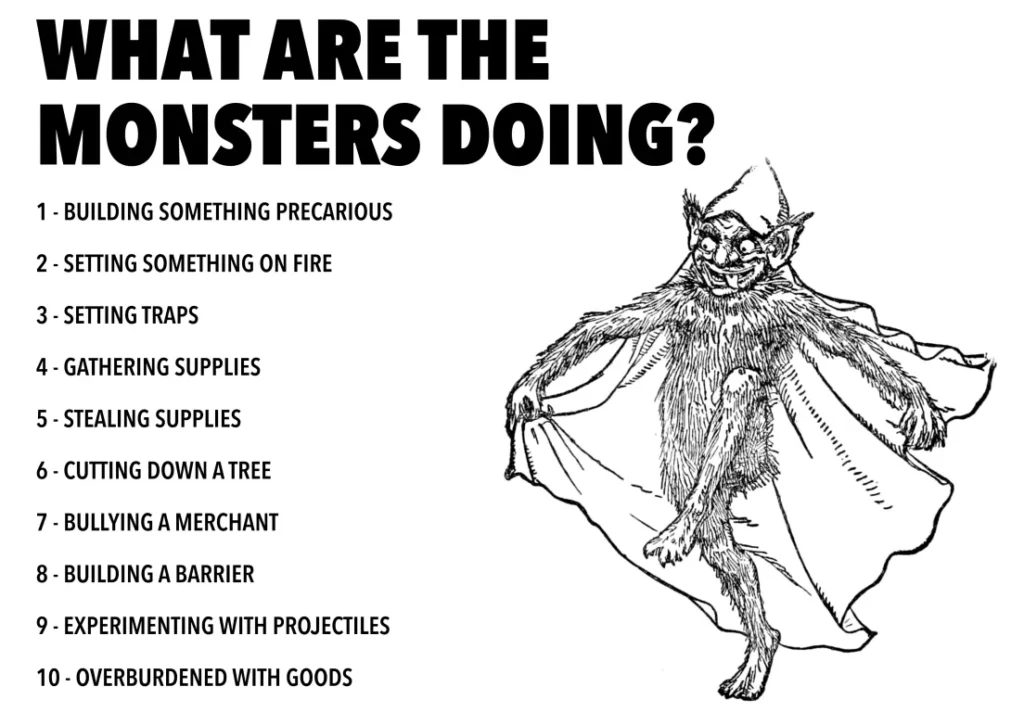
In line with this theme, here’s a “what is the encounter doing” table:

The words ‘what are the monsters doing?’
1.	Building something precarious
2.	Setting something on fire
3.	Setting traps
4.	Gathering supplies
5.	Stealing supplies
6.	Cutting down a tree
7.	Bullying a merchant
8.	Building a barrier
9.	Experimenting with projectiles
10.	Overburdened with goods

To the right is a dancing gremlin like creature with a cloak on

A painted mini with long white hair on the ground in front of trees and plants.

Written by Campbell Wright

INTRODUCTION:

In 2016, Matt Mercer appeared in a youtube video on Geek and Sundry titled: “Preparing for the Unexpected” where he talks about improvising and adapting to unexpected moments in TTRPG. As a part of this video, he talks about Improv: “The improvisational skill is useful in all facets of life I’ve found and this [TTRPGs] very much so”. Brennan Lee Mulligan at various times has talked about his background in Improv and his time at UCB (an Improv school in LA and New York), and its importance for Dimension 20. 


So why is Improv such a good background for Role Playing? In essence, Improv teaches many skills for effective storytelling and embodying a character – which is at the core of both running and playing TTRPGs. There are far too many skills and techniques to go into detail here, but I thought I could give a couple of examples of techniques from improv that can improve your role play, as both a facilitator and a player. 


I do want to make a quick note here and point out that the style of game that these tips are for is primarily a story focused one – not every TTRPG, or even every table, has a focus on story (For example, some more tactics focused RPG’s such as Lancer may have less story than something like Legends in the Mist). However, for the story heavy tables/TTRPGs I hope that some of this information will be useful.


FOR THE FACILITATORS:

An improvisational technique sometimes used to set the space is called “scene painting”. This simply refers to describing what is in the scene, and in some instances can include performers indicating where the objects/things are in the physical space, to allow the audience to imagine the physical room filling up with these imaginary descriptions. While TTRPG’s are often descriptive, I think that elements of this technique can be used to embellish our descriptions a little further.


In TTRPG’s there are a few different places we can apply this technique. The first is as players enter a new room, environment, or space. Describe to the players what is in the new environment, but make sure to discuss more than what is there. Engage the senses! Sounds, smells, touch, and even taste can be effective for establishing a tone or feeling in the new environment (Sounds and smells for example, are particularly effective for horror).


As you open the door to the king’s chambers, the heat hits you first. Despite your best efforts, black smoke fills your lungs and leaves you coughing, the taste of charred flesh in your mouth. Fearing the worst, you brush the acrid smoke aside and step through into the room. Your vision is limited by the black smoke that roils in the upper half of the room, but you hear the king cry out for help from the far side. You rush to him to see a large roast boar completely aflame. “My dinner!” the king wails.


Horror example (warning: body horror, skeleton):

As the eldritch energy fills the room, the walls begin to… twitch. There is a pulse, a heartbeat, accompanied by a soft, wet, sussuration. The air smells sharp – cool and moist, but electric. The quiet static that comes before a thunderstorm. Even as you turn to run the blast strikes you and your muscles begin to writhe of their own accord – not moving your skeleton, but detached and flailing independently beneath your skin. You turn to look at your fellow party members, but where Surai once stood is instead a gaunt skeleton, bones separating without ligaments to hold them together and rattling as they fall to the ground.


The second place this technique can be applied is in combat (for those TTRPG’s that employ it) – particularly when using a battlemap or similar to draw or indicate what is present in the combat arena. When using a battlemap, we can be more specific in terms of showing players exactly where things are within the area. It’s a good idea to add in some erroneous items that simply fill out the space – sometimes adding these little tidbits of set dressing can completely change the way a combat runs when players begin to mess with it.


The Witch’s cabin is full of strange arcane paraphernalia. You can hear a notebook on the desk whispering softly to itself, and the light from the oil lamps flickers, sending shadows skittering across the walls. You’re on edge, waiting for a sign of the witch when she suddenly leaps at you! Roll initiative…

Mary, you’re up first!

Mary: I know the witch is attacking us, but I would like to briefly examine the notebook on the desk – maybe we can use her own magiks against her?

etc…


Another extremely useful place that scene painting can be employed is in introducing players to the world. Imagine that our description is like a camera, floating far above the world. We start by describing the wider land – the place in which the game is taking place. Once you’ve given this initial description, we can then zoom in to the specific region within the land and describe it. Repeat again for the town, and for the specific locale within the town before “placing” one of the player characters in this location. Matt Mercer can be seen using this technique at the start of Critical Role campaigns 2 and 3 to great effect. This is very useful for providing players context to the wider world. In addition, it gives players a glimpse into the history and regions that surround them, and creates a sense of intrigue where players want to find out more about this place, or that historic event.


On the other hand, it is also a perfectly valid technique to dump players into the action immediately, and this is something that Brennan Lee Mulligan loves to do. His appearance at the start of critical role campaign 4 is an excellent example of this: “Someone you love, very much, is about to die”. This technique can be a little more… disorienting. But it can also immediately get players’ attention and hook them into being invested in the story.


Another technique which Improvisors discuss when storytelling is the difference between “Advancing” or “Extending” the story. Advancing refers to moving between narrative beats – the next story moment, the next plot hook. Extending refers to providing additional details – slowing down a moment to give additional descriptions about senses, emotions, and character details. Generally speaking, we are advancing the story wherever we can – introducing new villains, encounters, a new room of the dungeon. But, it is important to know when and where to slow the story down and let the players take a moment. Whether the moment is to explore the world, to play out a scene with another character, or discover their new favourite goofy shopkeep, it’s important to give players the space to play with the world and one another. The trick here is finding the right balance between the two. Too much Advancing and you’ll find your players are not invested in the world or their characters because they don’t feel them. Too much extending and your players will get bored and listless and may be struggling for ideas of what to do next. Alternating between Advancing and Extending effectively is key to telling a powerful story. 


FOR THE PLAYERS:

Many systems use descriptive elements to tease out who your character is and their place in the world. Dungeons and Dragons, for example, uses Ideals (your character’s morals, what your character stands up for), Bonds (People and places your character is connected to), and Flaws (vices, compulsions, fears, or weaknesses of the character). While these are useful for getting you in character, they don’t do a very good job of informing your character’s journey. When storytelling in Improv, one approach to quickly creating effective characters is to create a character that wants something. It’s all well and good to have a character with a tragic past, but if they don’t want something, or to change something about the world, they have nothing driving them forward on their quest. The thing your character wants doesn’t have to be obvious to themselves, or to the other players at the table, but if it is something that they want, desperately, it will help to drive them forward and motivate them in their quest/s. I think the reason that a system like Dungeons and Dragons does not include this in its character creation is because there is a presumption baked into the system that players are either adventuring for 1. Money, 2. To live out their Ideals/moral beliefs (i.e. because they are heroes they will do the right thing), or 3. Because the DM will give them a reason to go adventuring. While this presumption can work for some groups, I think a more interesting story can arise from characters that have their own wants that they are seeking to address. Even if that want is “to earn money for my family back home”, that is already a more interesting motivation than adventuring for personal greed. (Extra little writers trick for experts: make a character that desperately wants something, but in truth, and perhaps unbeknownst to them, they actually need something else).


Another trick to make your characters feel real and lived in is to allow your characters to be changed by the world. In many of the most effective stories, a character goes on a journey into the world and comes back different, changed, by their adventure. This may be due to new experiences, scars, or different beliefs than those they had when they left, to name some examples. In any case, a character that is changed and affected by the world around them is a far more interesting one than one that returns to town almost the same as they left. Role playing offers a myriad ways for characters to be challenged, to fail or succeed. Let your characters learn something from that journey, and allow them to change into something new over time. This is something that I think the players of Critical Role excel at. For example, the difference between some of their characters between the start and end of The Mighty Nein (Campaign 2) is huge, and a significant portion of this simply arises from allowing their characters to be changed by the world and one another.


OUTRO:

A final piece of advice – Be bold! Be boisterous. Make stuff up! Don’t be afraid to let your players make up things about the world and accept them as canon. As a player, don’t be afraid to make bold offers or strong character choices – they won’t ruin your facilitators plans, and often lead to new and exciting beats that the facilitator hadn’t planned for. TTRPGs are at their best when both players and facilitators/DMs are telling the story together. 

I hope that you find these tips useful and can take them to your table! There’s so many more techniques and ideas present in improvisation that I know I use in my games regularly, but not nearly enough time for me to write them all out in a single blog post. If you’re interested in learning more, Poprox Improv will be running an Introduction to Improv for TTRPG players course later this year (more information can be found here once it is available). 


Catch Vex on the Preparing for Playtesting panel, along with Cam Banks (Cortex Prime) on the KiwiRPG Twitch channel, at 7:30pm-9:30pm NZST Saturday 11th July / Saturday 8:30am BST / Saturday 3:30am EDT. The VOD will be uploaded to our YouTube after the week, and linked here.


Hey there, I’m Vex, and I’m a professional playtester (don’t worry, that’s a lie). You might be wondering why I’m here today, in this blog you’re reading. Well, a bog witch trapped my soul here, but forget about that. I wanna give you a little guide to playtesting so you can up your game on upping your game. As the title implies, this is a guide for your first time playtesters, or folks who feel they’re at a place where they can learn from basic advice. But I’m also going to try and keep it as brief as possible so it’s skimmable and serves as a good reference.

A photo of a shoe and a leg about to step on a banana peel.

Image from Nima Aksoy on Pexels.com


Why Am I Testing?

Most first time playtesters get to a point where they can say “Okay, my game is ready, now to see if people like it”. There’s two immediate problems with this I want to address:

  1. “My game is ready”

This isn’t the worst problem you can have, but it’s preferable that you hit playtesting before you feel you’ve completed your project.

  1. “Do people like the game?”

What you want to know is how you can improve the experience people have. People can be very uncritical of an experience they like, so by planning questions about the experience you get better feedback. Don’t let your testers face a yes/no question.

So if “My game is ready, do people like it?” isn’t a good reason to test, what are some good reasons?

  • “I want to test a small piece of my game” – isolated testing of pieces is good at finding problems that become harder to fix over time.
  • “I feel the project is going well” – GREAT time to check if other people agree.
  • “I feel something isn’t right” – new perspectives will help you identify things that are nagging at you.
  • “Things are working, but they aren’t streamlined” – asking people what things they struggle with, for instance things they struggle to remember during play, is a good way to find quality of life changes you can add.
  • “I want to know if the experience is what I planned” – checking that the parts come together without issues like sudden tonal changes is good to do near the end of the project.


These are just a few that come to mind. You might find some good reasons of your own. In fact, if this gets you thinking in a way that leads to finding your own reason, I’d say my job here is done.

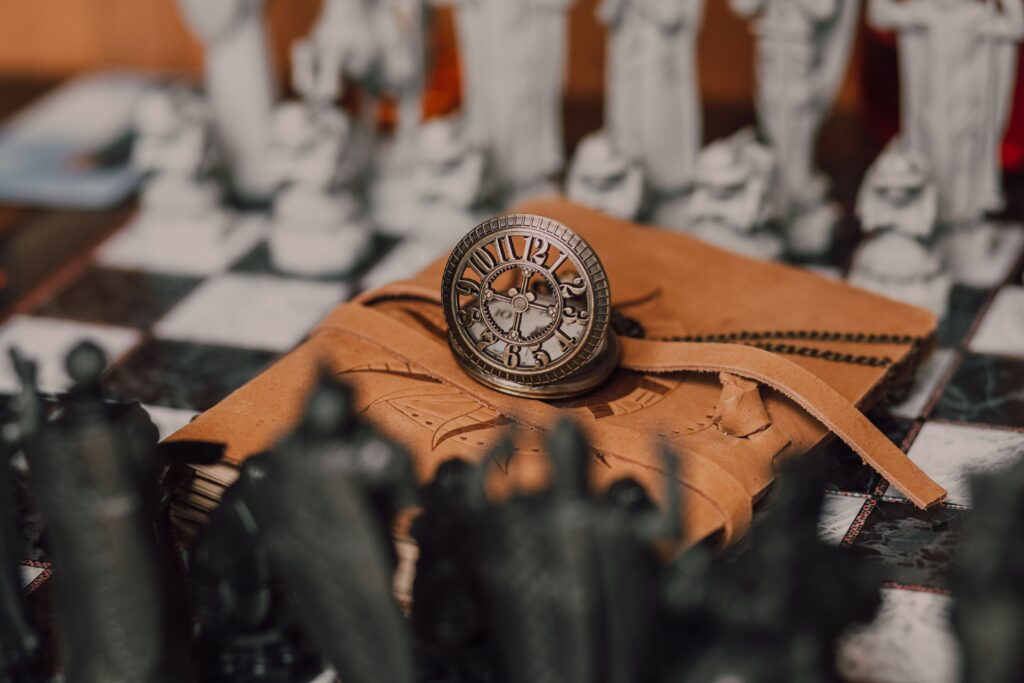
A steampunk pocket watch sits on top of a brown leather notebook, in the centre of a chess board with intricate chess pieces.

Image from RDNE Stock project on Pexels.com


What Am I Testing?

The best thing to do in a playtest is to come into it prepared to learn exactly the things you need to. My biggest recommendation is to have a notepad or even scrap of paper, something to keep time, and a bunch of questions you intend to have answered by the end of the test. Here’s some suggestions:

  • Do players understand the rules after reading them?
  • Can players play -without- understanding the rules?
  • Is there any information players need in front of them during play?
  • Is the tone of the game what you expected? Does it change during play?
  • Is the run time of the overall game, and its sections, as intended?
  • Does the game produce the emotion it was designed to?
  • Does the game have any accessibility problems?
  • Does the game appeal to its intended audience?
  • Are there any logical inconsistencies, such as in the ecology or economy?


I don’t recommend trying to cover all of these questions at once, but treat it like a pick and mix. Grab whatever speaks to you at the time. Again, add your own.


A person with brown skin and wearing a blue button up shirt, where the only part of them we can see is their thumbs up and some of their shirt.

Image from RDNE Stock project on Pexels.com


Annnnnd… Done!

You may have noticed that we’re at the end of the blog and we’ve only just covered what and why you’re testing. Well, it really is as simple as that. Have a good idea of what you’re seeking to learn and how you’re going to learn it, and your playtest will reward you with good information. Combine that information with a willingness to change what isn’t working, and you’ll breathe new life into your project.


Good luck, designer.


A picture of kawakawa, a plant with heart shaped green leaves.

Written by Riwhi Kenny. Catch Riwhi in the Māori Creators Panel alongside Liam Stevens (Toa Tabletop), Sascha Stronach (The Dawnhounds), and Te Aihe Butler (Fury of the Small), on the KiwiRPG Twitch at 1pm-2:30pm NZST Friday 10th July  / Friday 2am BST / Thursday 9pm EDT.

Please note that due to many Māori doing Matariki kaupapa (events) around this time, this panel is pre-recorded. It will be put on the KiwiRPG youtube after the week ends, and linked here once posted.


Tēnā koutou, he uri ahau nō Ngāi Tahu me Te Ātiawa. Ko Riwhi ahau, my name is Riwhi! If you’ve been paying attention, you may know my name from my account being the one posting all these amazing blogposts this week, and man, I have been loving all of them!

This is a blog post about manaakitanga, and the role it has in TTRPGs, at least to me. It’s a collection of a few different topics that I feel align to manaakitanga. It might be a bit scattered, but hopefully the thread of manaakitanga is made clear throughout.

Te Aka Māori Dictionary defines manaakitanga as:

(noun) hospitality, kindness, generosity, support – the process of showing respect, generosity and care for others.

I was taught that most words in te reo Māori (the Māori language) can be broken into parts. Manaakitanga, I was told, can be broken into mana-a-kī-tanga.

To break these down further:

Mana

Te Aka defines it as ‘prestige, authority, control, power, influence, status, spiritual power, charisma – mana is a supernatural force in a person, place or object.’ (This is just the first few lines, we don’t have all day!)

Okay, I really have not started this off smoothly. Mana is often translated into English as simply ‘spiritual power’, but this is, in my view, a completely inadequate translation. (And don’t get me started on the coopting of the term mana from its Pasifika roots into it’s current use in video games and some TTRPGs to mean magical power. Ew.)

There are two ways for someone to have mana. Mana Tipuna, the mana one is passed down from their ancestors; and mana tangata, the mana they have from acts that they take.

It is a deeply cultural term, and not even just specific to Aotearoa (so-called New Zealand)! It has whakapapa (lineage) across Te Moana-nui-a-Kiwa (the Pacific ocean). Mana is a concept that is genuinely so hard to explain if it is a new term, so I fear I am not at all doing a good job in defining it.

It’s a weight, a duty, an honour, a constant, a privilege, a burden, a strength, a hope, a promise, and more. It ties us all together, it puts us on different levels, it means something different to everyone.

A related term is ‘whakamana’. ‘whaka-’ as a prefix makes something into an action. So to whakamana someone is to, according to Te Aka:

to give authority to, give effect to, give prestige to, confirm, enable, authorise, legitimise, empower, validate, enact, grant.

One term that is still sometimes used is ‘mana enhancing’. There’s some mixed feelings about this one, as you cannot ‘enhance’ someone’s mana, you cannot change someone else’s mana, and also putting this English word next to it is a bit jarring!

Anyways, hardest part of this breaking apart, done, and we’re moving on.

A ki

to, into, towards, on to, upon – indicates motion towards something.

Tanga

I’ve heard two different whakaaro (thoughts) about this part of this kupu (word)! The first is the more traditional: -tanga, as an ending, turns something into a noun. So, using this interpretation, manaakitanga is a noun that is about moving towards mana.

The other interpretation I’ve heard is that tanga here relates to the kupu, ‘tangata’. Tangata means person/people. So, manaakitanga, can be described as mana moving toward the people.


While manaakitanga has elements of care, hospitality, generosity, etc etc, it’s a very very deep term that goes far beyond.

One other thing I’ve heard folks say about manaakitanga is that it holds a deep sense of reciprocity. Similar to ‘utu’, which Pākehā often think just means ‘revenge’ (when it’s often used for things as simple as payment for an item, not always that deep!), implies a relationship beyond a kind word.


How’s that for an intro? Now that I’ve broken down the word manaakitanga from what I’ve heard (disclaimer: certainly there will be Māori who disagree with my interpretations of the words here! Māori spaces thrive on deep kōrero (discussion) and wānanga (discussion but More) spaces), I’ll get into how I think manaakitanga can look within TTRPG spaces, or at least the ones I’ve been in.


The GM is a player too

I know that in a lot of Dungeons and Dragons TM circles (or at least some of the ones that pop up in my facebook algorithm), there’s a view that the DM is there to facilitate the game, and be in service of the players, and that’s all.

I reckon, and I know I certainly am not alone in this, that the GM is a player too! If we look at Indigenous models of leadership, the leader, in Māori spaces, the rangatira (loosely and euro-centrically translated as chief), is still a member of their community. They still are acknowledged to have wants and human needs outside of that role. Just as the rangatira takes care of their people, so do their people take care of their rangatira. While that rangatira often has a lot of mana tangata or mana tipuna if it’s a hereditary role, they are still a part of the community they serve, and deserve to be cared for.

In TTRPGs, we need to think about how DMs, GMs, facilitators, whatever the game’s term is, still deserve to be looked after! Especially the forever GM’s!

Now, I know many of us who play with our friends already do this, but I think we can all make clearer our appreciation for the mahi (work) and effort that our GMs put in! Go flick the GM for that game you’ve been playing for a while a ‘hey you said this killer line the other session, and it’s been sticking with me,’ or a ‘I know that you’ve put a whole lotta effort into running this game, and it is very appreciated’, is always going to be welcome.


Games about colonisation

I have been playing TTRPGs for almost 10 years, and it is only a couple of months ago that I had an Indigenous GM or DM. Don’t get me wrong, I’ve had wonderful and incredibly enjoyable times with non-Indigenous DMs, and being the only Māori in a game (took me ~9 years to play with another Māori person, speaking to the whiteness of these spaces), can be… interesting. 


As I processed my feelings around my Māoritanga in everyday life, it’s only natural that this spilled into my TTRPG playing experience. I wanted to explore and process my Indigeneity through roleplaying. For me, this has gone one of two ways:


1. My experience with non-Indigenous DMs:

The theme of colonisation is built into the world, but it is held with caution. It is up to me to engage with this in the ways I want to. I give my character a Māori name. In a scene with an NPC who has also been colonised, I experience strong bleed (see more below!). I work through this, and have a scene that feels cathartic in the end. Between the bleed starting and the working through it, I feel that I can’t bring my distress up at the table. Not for any fault of my friends, but because I have that internal feeling of whakamā (shame/guilt) that I should be better than this. No one else at the table is Māori. My friends support me when I communicate what I can. It is a struggle nonetheless to explore Indigenous stories and themes when I am the only one at the table.

I have discussions with a friend who DMs for a fellow Māori person where we kōrero (chat) about how to tell stories that are meaningful to your Indigenous players while not being Indigenous yourself. We talk about how some stories are not a Pākehā (non-Māori)’s place to tell. You follow the Indigenous person’s lead, about what they want to explore within their character, but do not base the whole game around colonisation.


2. My experience with an Indigenous DM:

Colonisation is explicitly a theme. Indigeneity is built into every part of the world. From the naming systems, place names, the colonising force and expressions of rebellion and fighting back, this world oozes indigenous thinking.

I feel no whakamā in tying my character’s backstory to colonisation. I feel no apprehension about exploring that, only an excitement for my explorations of it to be met in ways that reflect what I am giving.

The former has certainly not been a bad experience, as said before! I’ve enjoyed games with non-Indigenous DMs greatly! It is has just meant that I have had to tread lightly sometimes, or choose to verbally express some things and not others, and have felt that whakamā at times. There’s a freedom to playing in a game with Indigenous players and DM. 


Manaakitanga is all over this topic.


Non-Indigenous GMs who have Indigenous players need to show manaakitanga frequently! Let the player determine to what level they want to, or do not want to explore Indigenous themes. If this means you need to do some research in the background to make sure you’re doing it right, have fun learning new things! This is where safety tools can be very helpful! More on that below. Giving the player that agency is not just showing manaakitanga, going at their pace and level of comfort and interest, but also respecting their tino rangatiratanga (loosely translated as self-determination). 


Indigenous GMs with Indigenous players also show manaaki to each other! A TTRPG is often a conversation. Sure, sometimes there are rules to guide that conversation, but any conversation needs manaaki to succeed. Manaaki to check in, to meet the other person where they are at, to respect the edge of where they are willing to go. Intergenerational trauma is unfortunately present for Indigenous peoples, and sometimes it gets pinged by accident or unexpectedly. In my experience though, working through that with fellow Indigenous people means that there’s a base level of understanding there.


Bleed

I wrote something a few months ago that was my answer to a question I had thought about a little bit and wanted to explore: ‘what if something was designed to cause bleed?’ So, I wrote ‘BLEEDING HEART: A Character Creator’, which guides you through making a character, where every single facet of that character is taken from something in you, the player’s, life. 


This came after that experience I mentioned above, where I felt strong negative bleed after my Indigenous character met another Indigenous character. This was an overwhelming feeling, and as stated above, I felt unable to say anything to the whole table. Thankfully, one of the other players and I messaged occasionally during the game to make silly jokes where no one could hear us, and I was able to get across a feeling of distress to him somehow, and he called a pause for me, making up an excuse, and then after checking if it was okay with me, let the DM know I was having A Time. We skipped over the rest of the scene, and I was able to rest within the normal flow of the game. A couple of sessions later, my character had a deliberate conversation with that other character, and it became a moment of genuine healing for me, the player. 


Obviously after experiencing this strong bleed, the concept interested me. I wrote this character generator. And someone immediately confronted me on social media claiming that because I wrote a game about bleed meant that I thought it was a good thing. The convo spiralled once I brought up Aaron Trammell’s ‘Repairing Play: A Black Phenomenology’, and I realised that this person was simply not ready to engage with the kinds of conversation I wanted to have about bleed.


This didn’t mean that many other awesome people weren’t ready instead! So, I had wonderful conversation, and came to the conclusion that bleed is not inherently negative, nor inherently positive. My experience of bleed felt negative at the start, but with support, and care, and yes, manaaki, it turned to a positive one. I healed a part of my internal sense of intergenerational trauma. I got to imagine, through playing pretend, what it would be like if an ancestor was in front of me. What would I say? How would I act? What would I tell them, and what would I ask them to tell me? 


Bleed is neutral. It’s the care, the manaaki, that shifts it either to positive, in the holding of you, or the negative, if it is not done well.


GM-less games

Indigenous folks tell stories, that’s what we do. At least here in Aotearoa, Māori were an oral society. We didn’t have writing or letters or an alphabet. If something needed to last, we told it in carvings or weaving. If it was ready to be handed down though, it was through waiata (song), karakia (intention setting ritual), or whakapapa (~geneology). Oral communication was just how it worked.


Now, I will admit to this sitting slightly uncomfortably with me. I have a genuinely terrible memory, so I would not have been one of the ones able to recite the whakapapa lines. I do think though, storytelling comes quite naturally to me, as it does to many Indigenous people.


TTRPGs root in wargames, where there’s a single figure of authority, often lead many people to think that this is just how all TTRPGs work. Thankfully, that’s not the case! I’ve come across many wonderful GM-less games, about a range of different topics. Sometimes, it’s easier to write a game about something when the power is shifted from the head honcho method. 


Indigenous storytelling is not static. It shifts. With each telling, a good storyteller reads the audience and what they are reacting to, and will heighten that. They’re still telling the same story, the same content that has been passed down, but performing it differently. And as those people hear that story, they’ll pass it on, and tell it their way, and on and on. 


Stories are not isolated, they do not belong to one person. GM-less games bring that collaboration higher than the GM and player model can. Gives players an equal say.


Indigenous people are built from stories. What is whakapapa if not a collection of stories of your ancestors? To give room to them to tell stories, you are whakamana-ing them. You are showing manaakitanga. 


GM-less stories where control is shared and negotiated sit in a different space of power dynamics. They offer agency, in a world that tries to take it from Indigenous peoples often.


While manaaki can exist anywhere, I do think that GM-less games offer a particular spin on manaakitanga that starts from the ground up.


Aftercare

What is checking in with something after something difficult/intense/unexpected, if it is not showing manaakitanga? Checking in, asking how they are doing, is showing care, showing concern, showing aroha (~love), showing manaaki.


Maybe, using the term aftercare feels weird or gross. Think about that! All I am saying is that having language to describe the action of checking in and caring for someone after something intense is handy.


This is a pretty short section, as to me it feels pretty self explanatory, so moving on rapidly.


Safety (journeying) tools

If aftercare is reactive, than safety tools are preventative. I actually love the term that Jay Dragon uses in Wanderhome, in place of ‘safety’ as a kupu: journeying tools. 


To me, this feels more aligned to Māori ways of playing. Our ancestors traversed an extreme distance, and must have had things in place to ensure that haerenga (journey) was as safe as it could be.


Still, journeying tools, to me, implies a sense of curiosity and movement. You journey to seek something, or leave somewhere. Either way, things will change. 


Beyond the linguistic discourse of what we call these tools, they are ways that we keep each other and ourselves safe. There’s a lot of discussion on the role of these – some people argue against them in some circumstances, and some use certain ones religiously. 


This is the role of a session 0 if playing a longform game! Which, if any, will you use.


Setting these up is an act of manaakitanga. Acknowledging that pain exists, and attempting to define the edges of it, to ensure that those soft squishy places are not hurt is manaaki!


When these are respected in game, that’s manaaki! When they’re invoked, and you have already figured out how to solve/cope with that issue, that’s a wonderful preventative sense of manaaki.


Showing manaaki, and keeping someone at the level they want to be at to play a game means you get to play more game, yay!


He whakakapi – the end

Manaakitanga is foundational to Māori. It guides our relationships to each other, to ourselves. In this post, I’ve outlined a few ways that I think manaakitanga can show up in TTRPGs, and also started with defining the word. 


I invite you to reflect on how you can whakamana and show manaaki to the people in your TTRPG games and spaces, Māori or not. 


It is the season of Matariki, the Māori new year. KiwiRPG Week always aligns with it, and it offers us a wonderful invite to reflect on our lives in the past year, those we’ve lost, and what we want to do in the next year.


I personally, want to tell cool and interesting stories with my friends. I will be showing manaakitanga to my friends, and they will show it to me. Maybe sometimes we’ll stumble. Something will be done clumsily, or trauma will pop up unexpectedly, but I know that through showing manaakitanga to each other, we can work through those bumps, and tell wonderful stories once more.


Mānawatia a Matariki.

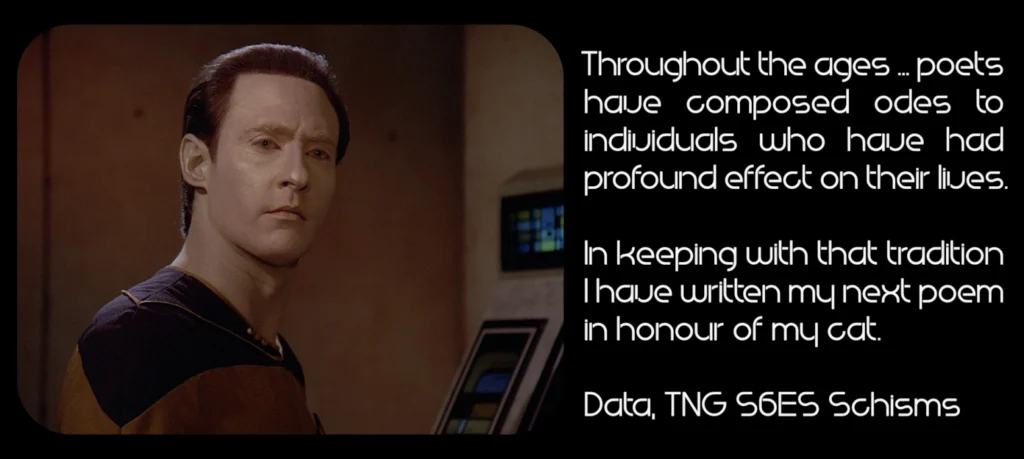
Data from TNG standing in front of computers, he's looking just off from the camera. Text to the right reads: Throughout the ages ... poets have composed odes to individuals who have had profound effect on their lives. In keeping with that tradition I have written my next poem in honour of my cat. Data, TNG S6E5 Schisms

Written by Kelly Whyte. Find Kelly on RPGTrader, itch.io, and DriveThruRPG


I was a late convert to Star Trek. I started with Deep Space 9 (DS9) before branching out into the other ‘mid-Trek’ series, including The Next Generation (TNG) and Voyager, and occasionally into New Trek, like Discovery or Lower Decks. There’s a lot of Trek, and while I vigorously fight being labelled a Trekkie, I probably should give in to the inevitable at this stage.


TNG is, for better or for worse, the definitive Star Trek series. It is dominant in the public consciousness, rivalled only by the original series, and almost all subsequent entries have been, in one way or another, a rebuttal to or continuation of TNG. DS9 was the dark underbelly of TNG’s utopia, Voyager transplanted the ethos of TNG to the frontier, even Enterprise tied itself to TNG with its infamous ending. Despite this, there’s been an aspect of TNG, a well-known and often mocked aspect, that tends to be overlooked when we talk about the setting’s utopia.


Ode to Spot

Felis catus is your taxonomic nomenclature,
An endothermic quadruped, carnivorous by nature;
Your visual, olfactory, and auditory senses
Contribute to your hunting skills and natural defenses.

I find myself intrigued by your subvocal oscillations,
A singular development of cat communications
That obviates your basic hedonistic predilection
For a rhythmic stroking of your fur to demonstrate affection.

A tail is quite essential for your acrobatic talents;
You would not be so agile if you lacked its counterbalance.
And when not being utilized to aid in locomotion,
It often serves to illustrate the state of your emotion.

O Spot, the complex levels of behavior you display
Connote a fairly well-developed cognitive array.
And though you are not sentient, Spot, and do not comprehend,
I nonetheless consider you a true and valued friend.

[Editors note: Embedding the video was not working, so please follow this link to get the full experience of Data’s rendition!]


The performing arts occupy a prominent position in TNG. Pick an episode at random and there’s a decent chance that you’ll see the crew rehearsing a play, performing a concert, or reciting poetry. Frame of Mind blurs the lines between fiction and reality as Riker descends into the world of a play he’s rehearsing. Data’s poetry night is the intro of the suspense episode Schism. Riker’s struggles to play the fictional song Night Bird on his trombone are part of the episode Second Chances; his struggles with the Chet Baker song Night Bird are sadly undocumented. 


Despite the ubiquity, it’s only occasionally that these performances command the A-, or even the B-plot of an episode.The works portrayed tend toward the classics (Shakespeare, Sherlock Holmes, Beethoven, Bach, etc.) for the simple reason that they’re in the public domain. Don’t worry, hold your high-school English class flashbacks; it’s not the content I find aspirational but the crew.


None of the TNG bridge crew were ever professional performers, for whatever utility the word ‘professional’ has in a post-scarcity utopia. Yet most of them take turns performing whatever talents they have and the reaction of their crewmates is almost uniformly positive. It is not uniformly uncritical however; in Schism, for instance, Geordi outlines to Data where his poetry comes up short and how he might improve, Crusher pushes Riker hard in rehearsing his part in Frame of Mind, and Picard’s critique is invited as Data seeks to understand Prospero in Emergence. The feedback is never given unkindly, but honestly when it is invited.


For us poor fools not yet living under fully automated luxury gay space communism, this strikes me as an aspirational situation. One where we’re not mere ‘consumers’ or critics, but active participants in the arts. So many things in the modern world hold us back from being creative; time, expense, lack of opportunity. These are difficult barriers to remove.


But there is perhaps one that’s in our control, and that’s how we treat those who do take the plunge and show us their art. I’m not suggesting we become mealy mouthed in our critiques, or give harmful tropes a free pass. But rather that we strive to be worthy members of a community that encourages people, regular people, to make, show, and grow their own art.


In the ttrpg space, we’re quite lucky in that our tables are theatres, each of us having the opportunity to be performer, author, audience and designer. To make creative choices, take creative risks, no matter how small. We are moved from consumer to creator, in playful collaboration with other creatives. No matter how proscriptive the system, there will inevitably be some space for the people around the table to create.


In subsequent Trek series, these performances are often absent. DS9 had visiting performers, but it’s rare that the bridge crew put themselves out there. Voyager has some, but there is a mean streak to them, such as when they plot a yellow alert to get out of the Doctor sharing his photography. It suits Voyager’s concept of a divided crew, with its incomplete integration of the Maquis members, or as another reminder of the stresses the stranded crew are under. 


Lower Decks is perhaps when performances are at their next most prominent after TNG, though even then they’re often fodder for jokes at the performer’s expense. Captain Freeman’s scat jazz performances or Lieutenant Bingston’s one-man shows are punchlines, in-universe they are treated tests of endurance and the character’s facade of civility rather than artistic expressions. Entire episodes of Lower Decks are still dedicated to characters’ artistic expression, most notably the Crisis Point episodes, but these tend towards just the small group of main characters, the community element is largely absent. 


While each of these series may have made the right choice for their own stories and tone, they are nevertheless stepping away from the aspirational and towards our mundane reality. We move away from a community of free self-expression and improvement back towards one that mocks and cringes at the imperfect efforts of those around us. TNG remains unique, the only time so far we have seen such an artistic community exist in the Trek universe. Despite its rarity, I personally prefer to think this is the way things are in the broader Trek universe, at least in this period. 


Certainly, the other series have means of the characters expressing themselves; Pike and Sisko do so through cooking, O’Brian and Bashir explore holodeck programs together, and one of the best episodes of DS9 has the crew bonding as a team over baseball. I don’t mean to discount those or suggest they have no importance for the characters or the audience. But TNG’s focus on the performing arts is the one that best exemplifies a vision for a place for creative community in humanity’s future.


Transporters and warp drives might be out of our reach for the time being. But we relate to the arts, to performing, and to the people who perform are already within our control. For all of us who enjoy Trek and want to see its utopian vision become a reality, this is a step we can all take.

A banner image with an artist sitting at her desk and drawing in a sketchbook, under which reads "The Immortal Think Tank Webcomics." Behind the artist is some of the art she's drawn - a dwarf blacksmith with a hammer on her shoulder, a half-elf adventurer with mimic armour, a male merperson with blue skin and a purple tail, an elderly lady shooting a steampunk styled gun, a d20, and a plushie mimic chest.

Written by Ché Crawford, who draws comics as The Immortal Think Tank. You can support Ché on Patreon.


The Foundation

One of the earliest memories I have is of five year old me being banished to the school library by an overwhelmed teacher because I couldn’t remember the word ‘it’ every time it was my turn to practise reading with her. Feeling for me, the librarian offered to read any story of my choice, and I chose the Brothers Grimm Cinderella – Aschenputtel. 

For those that have never had the pleasure of reading this version of the fairytale, it has many excellent and gruesome moments left out of its later iterations. The stepsisters cut off their toes and heels to fit into the slipper, blood drips from the shoes, and the happy ending was poetic justice unlike any little me had ever heard before – Cinderella’s magical doves tear the eyes out of those black hearted stepsisters, permanently blinding them! It was brutal, it was beautiful, and five year old me was enraptured. 

Stories were always encouraged at home. Over the years I was fed a steady diet of Greek mythology, Christian bible stories, and epic fantasy. Basically anything I could get my hands on to satiate my hunger for adventure. Stories were and are wonderful, and I vividly pictured myself there, battling alongside my favourite heroes in the name of all that is good and right. I developed into an idealist who firmly believed that humans at the core are good, and stories are what connect us. 

And I also developed into a bit of a dreamy, quiet, overthinker, that helped to cement me as ‘a bit of an odd one’ at school. But I didn’t mind. I just set out to collect others like me – the artists, the writers, the anime watchers, and I created a little, happy, creative bubble of friends to do school with. We drew, we wrote, we learned instruments, and I decided that whatever I did in the future, it needed to involve being surrounded by friends like these, telling stories in some form or another. 


Discovering Role-Playing Games

After a year of literature at Waikato University, I came to realise that I didn’t like telling stories with only words. I loathed riffling through my brain to describe what I pictured as a picture. Rolling green mountains, trees heavy with dew – yuck. I saw pictures, I needed to draw pictures. So, unable to find a course that was both writing and drawing, I packed myself off to Auckland to attend Freelance Animation School. 

There, I learned the foundations of drawing. I ‘leveled up’ to no longer drawing a person in a T pose. But it was an animation school, and the focus was on how to tell other people’s stories, frame by frame. I wasn’t in the writer’s room, involved in weaving the story together. I couldn’t even see the story. In front of me was 200 frames of a character slightly moving across the page. But moving where?! Doing what?!

Frame after frame, my brain grew weary. I was a machine, and the human aspect of telling stories was being kept from me, just out of reach. I wasn’t okay with that! But also I’d loaned thousands of dollars to be there, so I wasn’t about to skip out.

Determined to find some kind of adventure, I decided to drag a couple of new friends up to a group at Auckland University that I had heard about, the Auckland Roleplaying Guild, where my first interaction with a roleplaying game was not at the table, but was as a vampire in a live action roleplaying game. I found LARP, and it was brilliant. 

For the first time in my life, I wasn’t reading the story, or watching it, or writing it. I was in it. And I never wanted to leave. 

From there came Dungeons and Dragons, came people’s homebrew worlds, came Shadowrun. I was no longer reading Gandalf subtly working magic, I was Gandlf, not at all subtly working magic, and yes, it was me that set that flour mill on fire, accidentally doing significant damage (and some death, oops) to my fellow party members. 

I quested, I leveled, I got loot. I was good, I was bad, I was all shenanigans. And I knew, for the rest of my life, that roleplaying games would be important.


TTRPG Art 

I don’t know about you, but when I picture TTRPG art, I see art like what’s on Magic the Gathering cards. Beautiful, semi-realistic fantasy paintings, the kind that take years to learn how to do. But I hadn’t spent years learning how to paint like that, I’d spent years learning how to draw and animate funny little cartoons. 

And could I learn to draw like that? Possibly. But did I? No, not at all. Cartoons are fun. I like the silly shapes, the flaily limbs, the leaving off noses if I don’t feel like drawing them (which is almost always). I didn’t have an extensive portfolio of paintings to apply for jobs with. And because I’d seldom seen cartoons featured in TTRPG or fantasy books, I assumed that working professionally in that world was out of reach for me.

What I did have though, was a group of friends who came over to my house weekly for table top games. 

In my opinion, one of the best parts of playing table top roleplaying games is the community that can come with it. There’s a real sense of achievement when you down a big bad guy as a group. It bonds you in ways that are harder to notice in real life. “Good job, we both made enough money to pay our rent this week,” doesn’t quite feel as epic an achievement to bond over as “we saved the underdark from The Demon Queen of Fungi after months of questing together.” 

But it was much to my surprise that my favourite moments of these weekly games weren’t so much the epic adventures I always dreamed of going on. My favourite moments were the funny little shenanigans that happened around the table between my friends. I was desperate to never forget the silliest things we got up to. And also, in the back of my mind, I’d been wanting to draw out a fantasy graphic novel, but wasn’t happy with where my ability to draw was. Two birds with one stone, I’d practise and get better at drawing, while turning these moments into little four-paneled webcomics. 

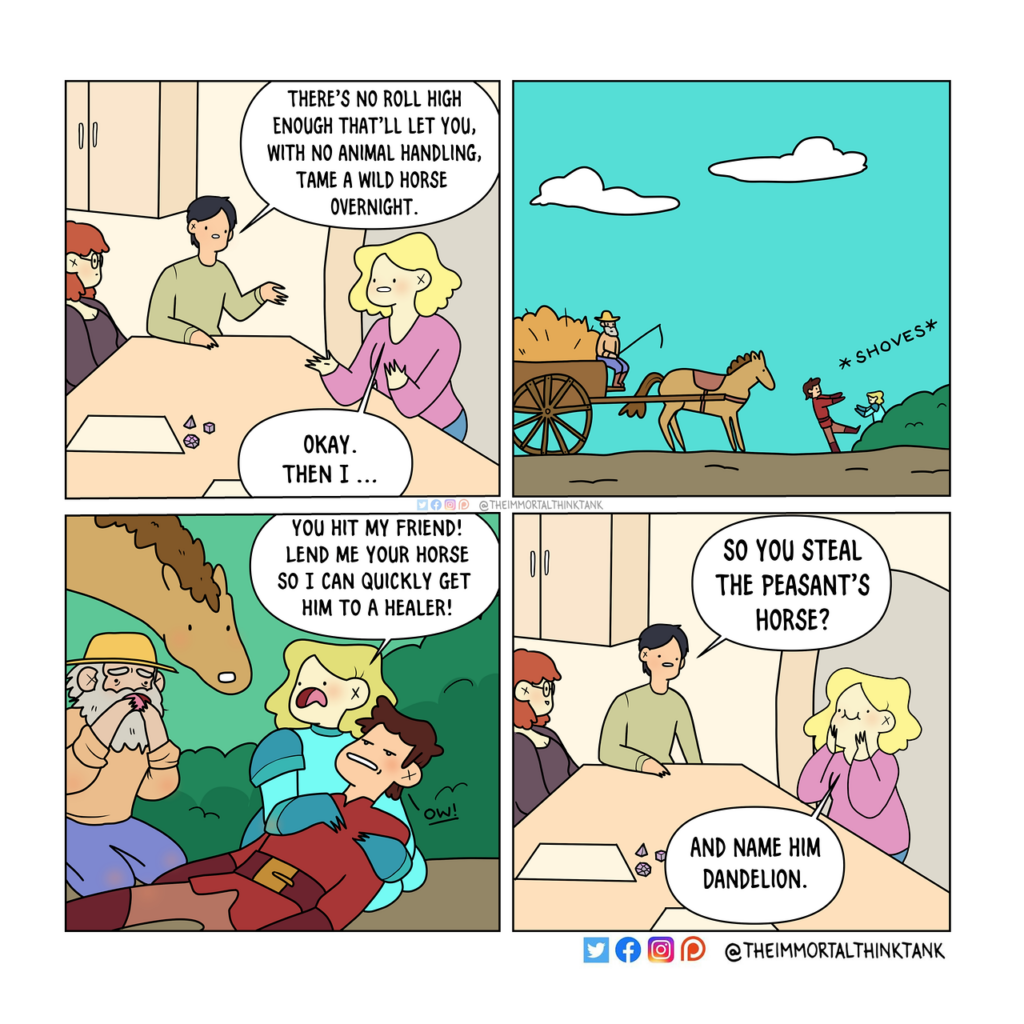
A four panel webcomic. In panel one, three players are sitting at a table playing a tabletop roleplaying game. They have character sheets and dice. 
The dungeon master says, "There's no role high enough that'll let you, with no animal handling, tame a wild horse overnight."
The player responds, "Okay. Then I..."
In Panel 2, the player's character pushes another character in front of a horse and cart being driven by a farmer. 
In Panel 3, the player says to the farmer, "You hit my friend! Lend me your horse so I can quickly get him to a healer!" The farmer and horse look alarmed.
In Panel 4, it shows the players back at the table. The DM asks the player, "So you steal the peasant's horse?"
The player looks pleased, and says, "and name him Dandelion."

From Webcomics to Paid Illustration

It took time, but through posting my comics on various social media websites, in particular D&D focused subreddits, I slowly built an audience that led to being paid to draw. I genuinely never thought I could work as an artist. But I was going to draw and tell stories regardless. It’s who I am. I can’t exist in any kind of happy or peaceful way without stories. 

The work came in stages. At first, the occasional commission for character art. It is always fun (although time consuming) to help a player bring to life their character visually. Patreon was the next step, then ad revenue on webtoon and facebook. They were all little amounts, but they can add up when you keep going steadily. 

But I am also a firm believer in asking for what you want. And one thing I wanted was to draw some comics for the sketch comedy group Viva la Dirt League. Their sketches were gaming shenanigans brought to life. 

They’re also evidence of what could happen when you just do the thing you want to do. No acting work? Create your own. Not many cartoons in the TTRPG world? Draw TTRPG cartoons anyway. I felt like we’d be a good match.

Viva la Dirt League was going to have a panel and signing at Auckland Armageddon. I remember asking a friend if it would be ‘cringe’ for me to turn up at the signing table with cartoons for them. I don’t remember his exact advice, but I’m pretty sure it was along the lines of ‘just be cringe then.’ So I went, I met them, I gave them art. Was it cringe? I don’t know. But they gave me a tour of their very cool studio and a commission for 20 comics based on their Epic NPC Man series. Twenty comics in my cartoony style. 

Che Crawford

Attachments6 Jul 2026, 14:11 (2 days ago)

to me
Hiya

Absolutely! I've popped them into a ZIP folder. They're named Banner, then image 1, 2, 3 etc, in relation to the order they show up in my post. 

I'm glad the blog post read okay. It occurred to me about one sentence in that it's actually been a while since I've written anything with so many words, haha. I wasn't sure if it made sense, and if the tone of it all was okay. I do really want to inspire more artists to pursue doing art for TTRPGs though. So often we see that one (very cool) high fantasy type art in ttrpgs, but I think just as we can have all kinds of games, we can have all kinds of art. So I'm glad it comes across as somewhat encouraging etc. 

I've done my best with Alt Text but I dunno what I'm doing really 😆 Hopefully it's okay. 

Alt Text

Banner
A banner image with an artist sitting at her desk and drawing in a sketchbook, under which reads "The Immortal Think Tank Webcomics." Behind the artist is some of the art she's drawn - a dwarf blacksmith with a hammer on her shoulder, a half-elf adventurer with mimic armour, a male merperson with blue skin and a purple tail, an elderly lady shooting a steampunk styled gun, a d20, and a plushie mimic chest. 

Image 1
A four panel webcomic. In panel one, three players are sitting at a table playing a tabletop roleplaying game. They have character sheets and dice. 
The dungeon master says, "There's no role high enough that'll let you, with no animal handling, tame a wild horse overnight."
The player responds, "Okay. Then I..."
In Panel 2, the player's character pushes another character in front of a horse and cart being driven by a farmer. 
In Panel 3, the player says to the farmer, "You hit my friend! Lend me your horse so I can quickly get him to a healer!" The farmer and horse look alarmed.
In Panel 4, it shows the players back at the table. The DM asks the player, "So you steal the peasant's horse?"
The player looks pleased, and says, "and name him Dandelion."

Image 2
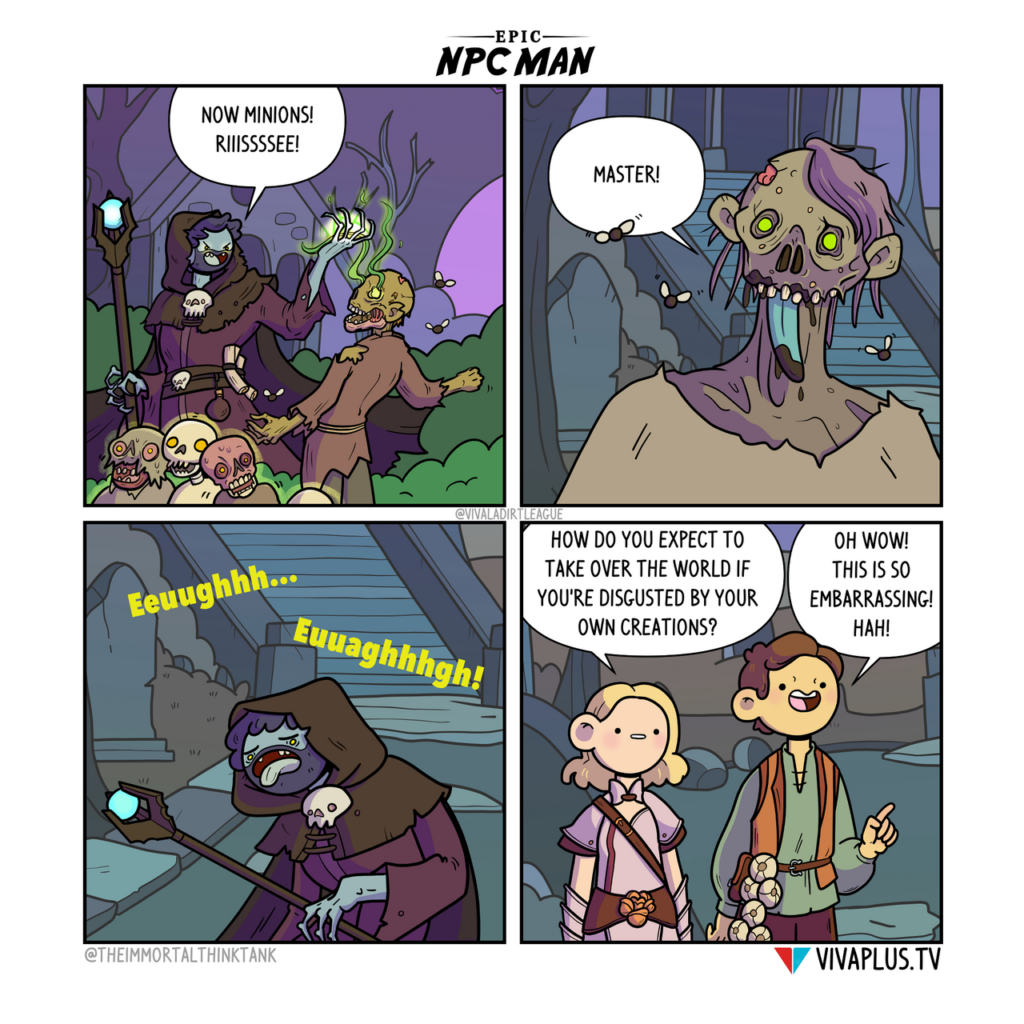
A four panel webcomic based on an Epic NPC Man sketch by Viva la Dirt League. In panel one, a necromancer is in front of a graveyard, using green magic to reanimate several dead bodies. He is wearing a black cloak, has skulls as a part of his outfit, and is wielding a staff. His hand is raised high with magic pouring too and from a rising body. He says, "Now minions! Rise!"
In Panel 2, a zombie missing its jaw, blue tongue hanging long and freely, flies buzzing around it says, "Master!"
In Panel 3, the necromancer gags in disgust.
In Panel 4, there is a woman in white armour, and the NPC 'Greg'. The woman asks the necromancer, "How do you expect to take over the world if you're disgusted by your own creations?"
Greg laughs at the necromancer and says, "Oh wow! This is so embarrassing! Hah!"

 I took this as an open invitation to be a professional TTRPG Cartoonist

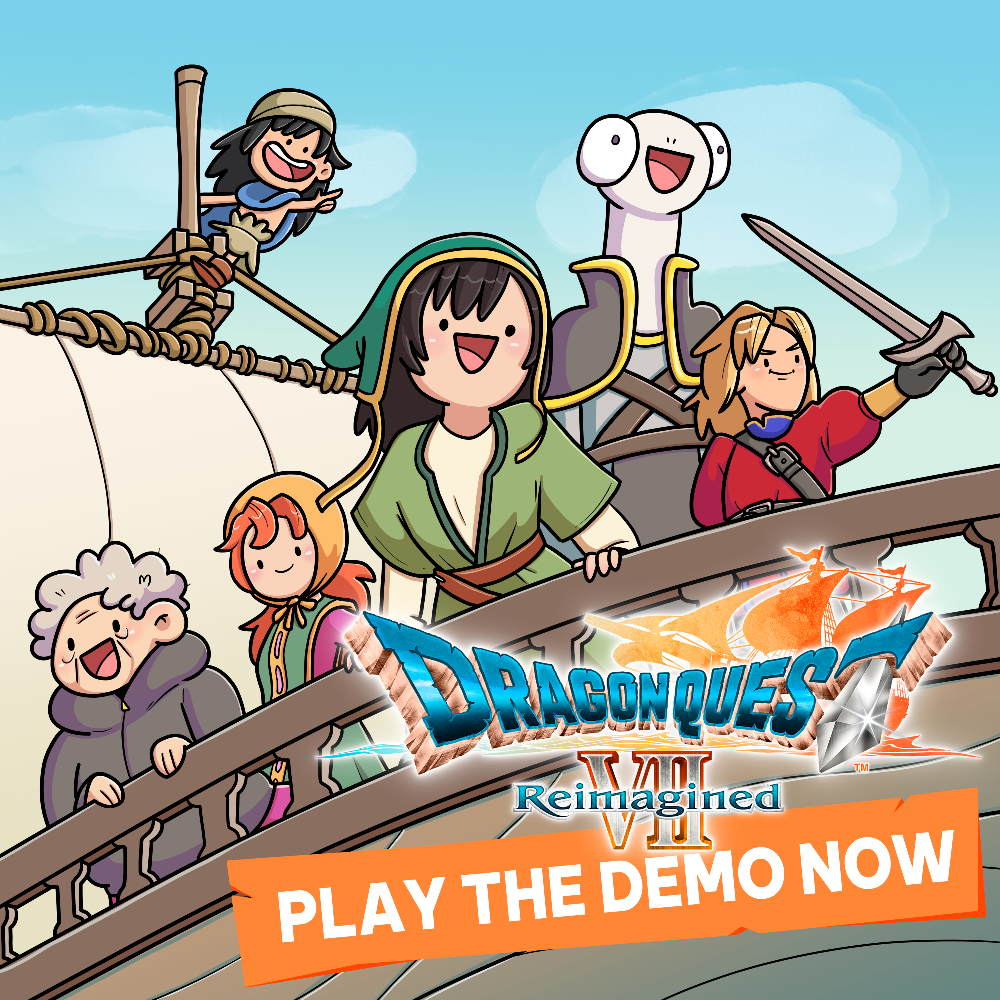
From there, I’ve drawn comic advertisements for Roll & Play Press, book covers such as the one I drew for Dumbest D&D’s Big Book of Little Adventures, and I even got to draw a comic for Square Enix’s Dragon Quest VII Reimagined, featuring my table top characters alongside theirs. 

The image is an advertisement for the remastered Dragon Quest Seven video game. It features a ship with a number of characters on it from the video game Dragon Quest seven, and from The Immortal Think Tank's webcomic Table Top. Near the front of the ship is a boy with shoulder length black hair, green clothing, and a green hat. He is leaning on the ship's rail, looking happily into the distance. Behind him from left to right is an elderly adventurer lady in a black hoodie, a young woman with ginger hair and a yellow headscarf, a tall lizardfolk with pauldrons and a gray robe, and a young man with golden hair, a red tunic, lifting a sword up high. Behind these characters, high up on the ship's mast is a young boy with long black hair pointing into the distance. All the characters look excited.
In front of the image is the text, "Dragon Quest seven reimagined, play the demo now."

There’s a whole spectrum of ways to draw, of stories to tell, of games to play, and lives to be had. So, this is my advice to you. If you want to do something, don’t wait to be invited, just do it. Storm your way through, make what you want to make, and know that whatever it looks like, it belongs. 


Advice for Emerging Artists 

My number one piece of advice is to be reliable. It can be intimidating getting your first commission. You might let the person down. It feels different to draw because you have to, instead of because you want to. Practice on your friends first. Get them to give you a character and draw it up for them on an estimated timeline and stick to it. People who hire artists want to know they’re going to get the art they need, in the time they need it. And once you’ve proven reliable, more work will come. 

Create an audience for yourself. Post to social media, show the world what you do. I am not the best artist. I absolutely know that some of the work I’ve gotten is because of the audience I have on social media. As an artist who draws TTRPG webcomics, I come ready made with the target audience many of the people who hire me are trying to reach. 

Don’t compare yourself to other artists. I believed I couldn’t work as this kind of artist because I drew cartoons. I compared myself to Magic the Gathering cards, to the loading screens on my games, and to the amazing painted illustrations in many of the books we consume. But I could, and you can. However you draw, whatever style, it belongs somewhere. 

And lastly, believe in the power of humans. In the age of generative AI, it can feel like there’s no place in the world for emerging artists. But I believe in you, a human, and what you want to make and share with the world, and so do many others. Our stories and our art connect us. And I plan to fight tooth and nail for creatives to keep creating. I hope you’ll join me in that battle – our epic quest, as fellow creatives. Let’s keep connecting with each other. 

Let’s keep shenanigans-ing. 

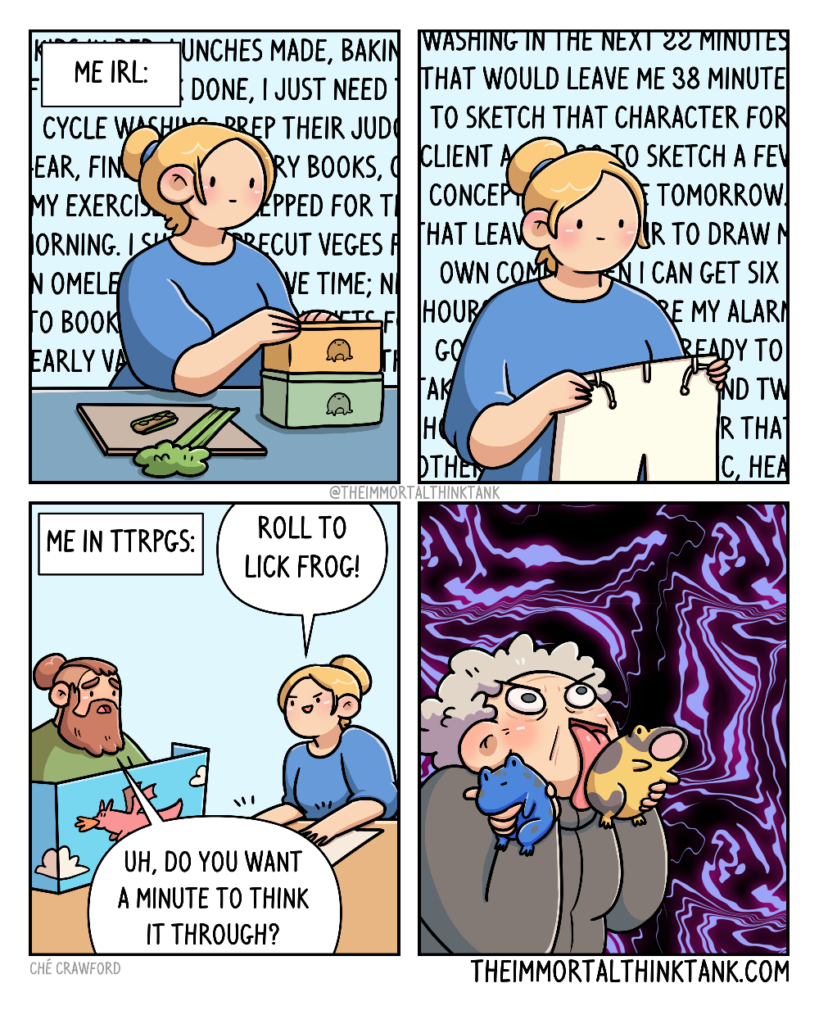
A four paneled webcomic by The Immortal Think Tank.
In panel one, there is a caption up top that says, "Me in real life." The image is of a woman making school lunches for her children. In the background is a wall of text, representing her thoughts. They say things like, lunches made, cycle laundry, prep their judo gear, find library books, precut vegetables, and so on, representing that she has a constantly running to-do list.
In panel two, she is holding up the judo pants she needed to find. Behind her are more scrolling thoughts such as, if I fold the laundry in the next 22 minutes, that would leave me 38 minutes to sketch that character for the client. It continues on to list more tasks and more time allotments to finish them in, to allow her six hours to sleep, before getting the children up for school, representing how much she's constantly thinking about her daily responsibilities. 
In panel three, the caption up the top says, "Me in tabletop roleplaying games." The image is of a man, behind a dungeon master's board, and the woman from the previous panels, playing a tabletop game. The woman says, "Roll to Lick Frog!" The dungeon master, looking concerned, asks, "Uh, do you want a minute to think it through?"
In panel four, an elderly woman, representing the character the woman plays in her game, is enthusiastically licking toxic looking yellow and blue frogs. The background has jagged purple lines swirling around, representing the impending hallucinations the character might suffer.

A picture of a notebook with notes from a solo rpg playthrough written in it, and a pen laying on top.

Catch Sam along with Sero making a solo rpg live on stream, as a part of KiwiRPG Week 2026 live on our Twitch on Tuesday 7th July, 1pm-4pm NZST / Tuesday 1am BST / Tuesday 8pm EDT. The VOD will be linked here after the panel.

The game they create will be played by Ruby on stream later that day, at 6pm-9pm NZST / Tuesday 7am BST / Tuesday 2am EDT.


Kia ora! My name is Sam, and I’m here to talk about solo roleplaying games.

What springs to mind when you hear the phrase ‘solo roleplaying game’? For some, solo journaling games occur first. Others might think of adaptations of popular games like Dungeons and Dragons and Pathfinder, where roll tables and oracles are used to simulate playing with a GM. Whatever springs to mind, there is no one right answer. Like the broader tabletop roleplaying label solo roleplaying games (called ‘solo rpgs’ for short) cater to a range of player tastes.

Journaling games encourage players to sit with their thoughts and explore a character in a way not easily achieved in a group setting. Cassie Mothwin’s Tangled Blessings generates story prompts with tarot as the player looks back on years of magical studies. Two Graves by our own Oru Games uses both dice and playing cards to explore a quest for vengeance, from the inciting incident to the act of revenge. The recently released Pride & Putrefaction by gothHoblin (Emma Grier) incorporates coins as well as dice in guiding the player through a romantic period drama full of zombies. Although overall lighter in tone than those previously mentioned, topics like death and helplessness still hit where it hurts at unexpected moments and encourage a pause for reflection.

Not everyone enjoys writing exercises. Other gamers chase the experience of exploration and adventure found in many group tabletop experiences. While adaptations of multiplayer games exist, other adventurous experiences were created specifically with solo gamers in mind. Shawn Tomkin’s Ironsworn is the classic example. In Ironsworn, players roll dice to explore the land, overcome obstacles and even assess how well they are pursuing their titular iron vows. In my Ironsworn chronicle, my character had vowed revenge on the father who left her for dead. While interrogating her uncle about his whereabouts, the dice were not in her favour and she ended up killing him.

If I was writing a story on my own, or even journaling in response to a prompt, I probably would have introduced a less disruptive complication. Ironsworn is the closest experience I’ve found to the surprise twists and turns experienced in a multiplayer game, but it’s far from the only one out there. As of writing, RPG Trader alone lists 380 entries under the ‘solo’ tag, while on Itch the ‘solo rpg’ tag has over 6000 entries. There’s something out there for everyone and it’s worth taking the time to browse and see the breadth of experiences on offer.

Maybe you’ve already played a few solo rpgs and are hungry to emulate a particular experience. This is where the Solo RPG List comes in handy! This is an incredible resource for finding solo (and two-player) tabletop games. It’s easily filtered by your favourite tags. Are you like me and constantly looking for more vampire games? Did you enjoy Ironsworn and want to play more games based on that system? Type in your desired keyword and browse the results.

Do you have a favourite solo rpg? Did a solo rpg experience touch you more than expected? Shout it out below! In this case, there can never be too much of a good thing.

-Sam

The words 'd12GO!' and 'The universal RPG' over a pink sky with the tops of pink mountains.

Catch Brad running a game of d12GO! as a part of KiwiRPG Week 2026 live on our Twitch on Thursday 9th July, 6pm-9pm NZST / Thursday 7am BST / Thursday 2am EDT. The VOD will be linked here after the panel.

Designer Brad Zimmerman leads a game of the flexible and fun d12Go. A completely randomly-rolled game: what will the dice bring, and how will a team of brave players handle it?


Hey there, Kiwi RPG folks!

My name is Brad and I am the creator of a game called d12GO! The elevator pitch for d12GO is that it’s a universal system for running roleplaying games in any genre or setting, without having to spend a lot of time learning new games for each.

For this reason, it has been used by a lot of people who want to play a quick one-shot session, with minimal prep.

I love running improvised game sessions, but I also understand that these can be very daunting, especially for people who usually run pre-written modules or supplements and aren’t used to stretching their improv muscles.

In this post, I thought I would whip up a few things I’ve learned about running unprepped one-shot games, that hopefully you may find useful.

Once the group has decided on a genre and a system (e.g. playing a “Teen Detective Story” using “Monster of the Week” by Michael Sands, etc.), whip up some characters, then jump into the below steps.


1. Outline the Story Together

Ask the players for ideas about things to include in the story (unless you already have a pretty firm idea yourself). Maybe you’ve thought of WHAT is happening, but not WHY it’s happening or WHO is behind it. The players are just as responsible for worldbuilding as you are, so don’t feel like it’s all on your shoulders. 

Scribble down a few brief notes (for yourself), describing:

  • Where a story like this would likely start
  • What kind of events might take place in the middle
  • What the climax may look like

It’s important to remember that everything you outline for an improvised game can be vague and unpolished. Nobody in your group expects perfection!


2. Make Quick Character Intros

Longwinded character explanations and backstories are great when you have a whole months-long (or years-long) campaign ahead of you. But in a short game, they only serve to slow everything down and chew up valuable time at the table. 

Get the players to describe:

  • One or two key points about their character’s outer appearance
  • One or two key points about their behaviour or motivations
  • Whether or not their character is prepared (physically or mentally) for the situation


3. Lock in a Firm Starting Point

Once everyone knows who they are and how their character behaves in the game world, put all the player characters into the same place, with them already informed about the “main situation” of the story.

I’ve made the mistake of letting characters “find their own way to the story”, which resulted in a “one-shot” that lasted 8 sessions… I won’t make that mistake again and I hope you don’t either!

A good idea is to summarise to the players:

  • What the main situation of the story is (e.g. “The local theme park is under attack by what reports are suggesting is an army of mutated pumpkins”)
  • Then tell them exactly where they are (e.g. “You are standing together in the parking lot, as parkgoers flee all around you”)


4. A Call to Action!

From the established starting point, get the story underway immediately, by forcibly hurling the characters into the fray with a call to action

Depending on the type of story, this could take any number of forms, including:

  • An innocent NPC pleading for help (either face-to-face or via a remote means)
  • Signs of an impending disaster (e.g. a rapidly spreading fire, a falling tower, a space station plummeting towards a planet, etc.)
  • A hostile creature chasing them into danger
 
5. A Low-Stakes Challenge

Get the players rolling dice as soon as possible, but keep the stakes relatively low for this first outing. 

This challenge may be something like:

  • A social encounter (e.g. convincing someone to give you access to a location or resource, etc.)
  • A physical obstacle (e.g. a precarious rope bridge, a vine-covered rock wall, a locked mansion gate, etc.)
  • An easy combat situation such as goblins or minion-level creatures of some kind.

Ideally, overcoming this first challenge should grant the player characters access to a new location, a valuable resource, or more information about what’s going on. 


6. Check Back with the Players

This is something you can do at any time during the game, but it’s good to get a gauge early on (especially if the first challenge was harder than intended).

Ask how their characters are feeling about the situation that is unfolding. This might help you flesh out the remainder of the story. Maybe they’ve got theories or ideas you never even considered.

Ask them if their characters want to rest, gather resources (e.g. ammunition, safety equipment, transportation, etc.) before continuing.


7. A Medium-Stakes Challenge (and a twist?)

When they’re ready, prompt the players to keep moving further into the situation, to the next significant location or point of interest.

There, they should come upon another challenge. This should be noticeably more difficult than the last one, and ideally require a different skillset or strategy (i.e. don’t make this just a harder version of the first challenge).

This is also a great time to add a little (optional) depth or intrigue to the story by throwing in a twist or unexpected complication.

Some ideas for a twist/complication could be:

  • The person or organisation that sent you here was actually trying to get rid of you
  • The main antagonist is revealed and it’s someone from your past
  • A tool or useful resource suddenly stops being useful (either because it’s broken or the problem adapts to make it redundant)
  • The true scope of the situation is revealed and it’s not what you had assumed (either it’s much larger or much more isolated than anticipated)
  • An assumption you made about the situation turns out to be completely wrong

The medium-stakes challenge (and twist) should reveal the narrative path to the final confrontation. This may be a literal path (like a mountain pass or broken trail deep in the jungle) or a guaranteed sequence of events. 

Either way, the endgame should be apparent to the players by now, but they must be given time to prepare, instead of being forced directly into it.


8. The Climax

The climax of the story is heavily dependent on the type of story you’re telling, but may be:

  • A boss fight. This could be a singular powerful enemy, or a large group of enemies that need to be defeated or overcome. In either instance, it should be more difficult than the medium-stakes challenge, and the players should be made very aware of that fact. 
  • A large-scale disaster (e.g. a nuclear reactor counting down to explosion, a dam bursting, a high-speed chase, a thrilling escape scene, etc.)
  • A very difficult physical obstacle to overcome (e.g. climbing an icy cliff while being bombarded with attacks from above, piloting a malfunctioning spaceship as it hurtles towards a city, etc.)

Whichever of these climaxes your game includes, try to incorporate multiple phases to add depth and get the players to try out different skills. 

For example, the boss fight could start with weak enemies that are only trying to slow you down while the big bad gets ready. If the players somehow manage to circumvent the weaker enemies, reward them by letting them know the big bad isn’t at full strength. 

Or the nuclear reactor escape requires a set of keys in order to get to the outside (fetch-quest-style), and then you enter the fleeing phase. 


Important Things to Remember
  • The entire point of the game is to have fun. You know this, and so do your players.
  • Checking in with your players for ideas is always valid. This can be especially helpful with fun little details that don’t really affect the story (e.g. “There’s a person cornered by the monster and screaming for help. What does this person look like?”)
  • Drawing inspiration from existing media is absolutely fine. If you want to take some plot points from The Terminator or Power Rangers or Dragonball Z, no one will stop you.
  • Say “YES” more than you say “NO”. Obviously there will be times that a no is required, but if you err on the side of yes, your players’ ideas will help create something truly unique and memorable.
  • A one-shot game means there is no larger narrative at stake. You don’t need to worry about accidentally setting up a huge problem later on because THERE IS NO LATER ON.


So, yeah, those are my thoughts about running improvised one-shots. Please remember these are opinions based on my own experience and will almost certainly be contentious and downright incorrect to some game masters. 

Regardless, I hope you can take something useful away from this and go have some fun.


SUMMARY
  1. Outline the Story Together
  2. Make Quick Character Intros
  3. Lock in a Firm Starting Point
  4. A Call to Action!
  5. A Low-Stakes Challenge
  6. Check Back with the Players
  7. A Medium-Stakes Challenge (and a twist?)
  8. The Climax


Thanks for reading!

Brad Zimmerman


Watch d12GO! as an actual play stream, Thursday 9th July: 6pm-9pm NZST on KiwiRPG’s Twitch.