A painted mini with long white hair on the ground in front of trees and plants.

Written by Campbell Wright

INTRODUCTION:

In 2016, Matt Mercer appeared in a youtube video on Geek and Sundry titled: “Preparing for the Unexpected” where he talks about improvising and adapting to unexpected moments in TTRPG. As a part of this video, he talks about Improv: “The improvisational skill is useful in all facets of life I’ve found and this [TTRPGs] very much so”. Brennan Lee Mulligan at various times has talked about his background in Improv and his time at UCB (an Improv school in LA and New York), and its importance for Dimension 20. 


So why is Improv such a good background for Role Playing? In essence, Improv teaches many skills for effective storytelling and embodying a character – which is at the core of both running and playing TTRPGs. There are far too many skills and techniques to go into detail here, but I thought I could give a couple of examples of techniques from improv that can improve your role play, as both a facilitator and a player. 


I do want to make a quick note here and point out that the style of game that these tips are for is primarily a story focused one – not every TTRPG, or even every table, has a focus on story (For example, some more tactics focused RPG’s such as Lancer may have less story than something like Legends in the Mist). However, for the story heavy tables/TTRPGs I hope that some of this information will be useful.


FOR THE FACILITATORS:

An improvisational technique sometimes used to set the space is called “scene painting”. This simply refers to describing what is in the scene, and in some instances can include performers indicating where the objects/things are in the physical space, to allow the audience to imagine the physical room filling up with these imaginary descriptions. While TTRPG’s are often descriptive, I think that elements of this technique can be used to embellish our descriptions a little further.


In TTRPG’s there are a few different places we can apply this technique. The first is as players enter a new room, environment, or space. Describe to the players what is in the new environment, but make sure to discuss more than what is there. Engage the senses! Sounds, smells, touch, and even taste can be effective for establishing a tone or feeling in the new environment (Sounds and smells for example, are particularly effective for horror).


As you open the door to the king’s chambers, the heat hits you first. Despite your best efforts, black smoke fills your lungs and leaves you coughing, the taste of charred flesh in your mouth. Fearing the worst, you brush the acrid smoke aside and step through into the room. Your vision is limited by the black smoke that roils in the upper half of the room, but you hear the king cry out for help from the far side. You rush to him to see a large roast boar completely aflame. “My dinner!” the king wails.


Horror example (warning: body horror, skeleton):

As the eldritch energy fills the room, the walls begin to… twitch. There is a pulse, a heartbeat, accompanied by a soft, wet, sussuration. The air smells sharp – cool and moist, but electric. The quiet static that comes before a thunderstorm. Even as you turn to run the blast strikes you and your muscles begin to writhe of their own accord – not moving your skeleton, but detached and flailing independently beneath your skin. You turn to look at your fellow party members, but where Surai once stood is instead a gaunt skeleton, bones separating without ligaments to hold them together and rattling as they fall to the ground.


The second place this technique can be applied is in combat (for those TTRPG’s that employ it) – particularly when using a battlemap or similar to draw or indicate what is present in the combat arena. When using a battlemap, we can be more specific in terms of showing players exactly where things are within the area. It’s a good idea to add in some erroneous items that simply fill out the space – sometimes adding these little tidbits of set dressing can completely change the way a combat runs when players begin to mess with it.


The Witch’s cabin is full of strange arcane paraphernalia. You can hear a notebook on the desk whispering softly to itself, and the light from the oil lamps flickers, sending shadows skittering across the walls. You’re on edge, waiting for a sign of the witch when she suddenly leaps at you! Roll initiative…

Mary, you’re up first!

Mary: I know the witch is attacking us, but I would like to briefly examine the notebook on the desk – maybe we can use her own magiks against her?

etc…


Another extremely useful place that scene painting can be employed is in introducing players to the world. Imagine that our description is like a camera, floating far above the world. We start by describing the wider land – the place in which the game is taking place. Once you’ve given this initial description, we can then zoom in to the specific region within the land and describe it. Repeat again for the town, and for the specific locale within the town before “placing” one of the player characters in this location. Matt Mercer can be seen using this technique at the start of Critical Role campaigns 2 and 3 to great effect. This is very useful for providing players context to the wider world. In addition, it gives players a glimpse into the history and regions that surround them, and creates a sense of intrigue where players want to find out more about this place, or that historic event.


On the other hand, it is also a perfectly valid technique to dump players into the action immediately, and this is something that Brennan Lee Mulligan loves to do. His appearance at the start of critical role campaign 4 is an excellent example of this: “Someone you love, very much, is about to die”. This technique can be a little more… disorienting. But it can also immediately get players’ attention and hook them into being invested in the story.


Another technique which Improvisors discuss when storytelling is the difference between “Advancing” or “Extending” the story. Advancing refers to moving between narrative beats – the next story moment, the next plot hook. Extending refers to providing additional details – slowing down a moment to give additional descriptions about senses, emotions, and character details. Generally speaking, we are advancing the story wherever we can – introducing new villains, encounters, a new room of the dungeon. But, it is important to know when and where to slow the story down and let the players take a moment. Whether the moment is to explore the world, to play out a scene with another character, or discover their new favourite goofy shopkeep, it’s important to give players the space to play with the world and one another. The trick here is finding the right balance between the two. Too much Advancing and you’ll find your players are not invested in the world or their characters because they don’t feel them. Too much extending and your players will get bored and listless and may be struggling for ideas of what to do next. Alternating between Advancing and Extending effectively is key to telling a powerful story. 


FOR THE PLAYERS:

Many systems use descriptive elements to tease out who your character is and their place in the world. Dungeons and Dragons, for example, uses Ideals (your character’s morals, what your character stands up for), Bonds (People and places your character is connected to), and Flaws (vices, compulsions, fears, or weaknesses of the character). While these are useful for getting you in character, they don’t do a very good job of informing your character’s journey. When storytelling in Improv, one approach to quickly creating effective characters is to create a character that wants something. It’s all well and good to have a character with a tragic past, but if they don’t want something, or to change something about the world, they have nothing driving them forward on their quest. The thing your character wants doesn’t have to be obvious to themselves, or to the other players at the table, but if it is something that they want, desperately, it will help to drive them forward and motivate them in their quest/s. I think the reason that a system like Dungeons and Dragons does not include this in its character creation is because there is a presumption baked into the system that players are either adventuring for 1. Money, 2. To live out their Ideals/moral beliefs (i.e. because they are heroes they will do the right thing), or 3. Because the DM will give them a reason to go adventuring. While this presumption can work for some groups, I think a more interesting story can arise from characters that have their own wants that they are seeking to address. Even if that want is “to earn money for my family back home”, that is already a more interesting motivation than adventuring for personal greed. (Extra little writers trick for experts: make a character that desperately wants something, but in truth, and perhaps unbeknownst to them, they actually need something else).


Another trick to make your characters feel real and lived in is to allow your characters to be changed by the world. In many of the most effective stories, a character goes on a journey into the world and comes back different, changed, by their adventure. This may be due to new experiences, scars, or different beliefs than those they had when they left, to name some examples. In any case, a character that is changed and affected by the world around them is a far more interesting one than one that returns to town almost the same as they left. Role playing offers a myriad ways for characters to be challenged, to fail or succeed. Let your characters learn something from that journey, and allow them to change into something new over time. This is something that I think the players of Critical Role excel at. For example, the difference between some of their characters between the start and end of The Mighty Nein (Campaign 2) is huge, and a significant portion of this simply arises from allowing their characters to be changed by the world and one another.


OUTRO:

A final piece of advice – Be bold! Be boisterous. Make stuff up! Don’t be afraid to let your players make up things about the world and accept them as canon. As a player, don’t be afraid to make bold offers or strong character choices – they won’t ruin your facilitators plans, and often lead to new and exciting beats that the facilitator hadn’t planned for. TTRPGs are at their best when both players and facilitators/DMs are telling the story together. 

I hope that you find these tips useful and can take them to your table! There’s so many more techniques and ideas present in improvisation that I know I use in my games regularly, but not nearly enough time for me to write them all out in a single blog post. If you’re interested in learning more, Poprox Improv will be running an Introduction to Improv for TTRPG players course later this year (more information can be found here once it is available). 


Catch Vex on the Preparing for Playtesting panel, along with Cam Banks (Cortex Prime) on the KiwiRPG Twitch channel, at 7:30pm-9:30pm NZST Saturday 11th July / Saturday 8:30am BST / Saturday 3:30am EDT. The VOD will be uploaded to our YouTube after the week, and linked here.


Hey there, I’m Vex, and I’m a professional playtester (don’t worry, that’s a lie). You might be wondering why I’m here today, in this blog you’re reading. Well, a bog witch trapped my soul here, but forget about that. I wanna give you a little guide to playtesting so you can up your game on upping your game. As the title implies, this is a guide for your first time playtesters, or folks who feel they’re at a place where they can learn from basic advice. But I’m also going to try and keep it as brief as possible so it’s skimmable and serves as a good reference.

A photo of a shoe and a leg about to step on a banana peel.

Image from Nima Aksoy on Pexels.com


Why Am I Testing?

Most first time playtesters get to a point where they can say “Okay, my game is ready, now to see if people like it”. There’s two immediate problems with this I want to address:

  1. “My game is ready”

This isn’t the worst problem you can have, but it’s preferable that you hit playtesting before you feel you’ve completed your project.

  1. “Do people like the game?”

What you want to know is how you can improve the experience people have. People can be very uncritical of an experience they like, so by planning questions about the experience you get better feedback. Don’t let your testers face a yes/no question.

So if “My game is ready, do people like it?” isn’t a good reason to test, what are some good reasons?

  • “I want to test a small piece of my game” – isolated testing of pieces is good at finding problems that become harder to fix over time.
  • “I feel the project is going well” – GREAT time to check if other people agree.
  • “I feel something isn’t right” – new perspectives will help you identify things that are nagging at you.
  • “Things are working, but they aren’t streamlined” – asking people what things they struggle with, for instance things they struggle to remember during play, is a good way to find quality of life changes you can add.
  • “I want to know if the experience is what I planned” – checking that the parts come together without issues like sudden tonal changes is good to do near the end of the project.


These are just a few that come to mind. You might find some good reasons of your own. In fact, if this gets you thinking in a way that leads to finding your own reason, I’d say my job here is done.

A steampunk pocket watch sits on top of a brown leather notebook, in the centre of a chess board with intricate chess pieces.

Image from RDNE Stock project on Pexels.com


What Am I Testing?

The best thing to do in a playtest is to come into it prepared to learn exactly the things you need to. My biggest recommendation is to have a notepad or even scrap of paper, something to keep time, and a bunch of questions you intend to have answered by the end of the test. Here’s some suggestions:

  • Do players understand the rules after reading them?
  • Can players play -without- understanding the rules?
  • Is there any information players need in front of them during play?
  • Is the tone of the game what you expected? Does it change during play?
  • Is the run time of the overall game, and its sections, as intended?
  • Does the game produce the emotion it was designed to?
  • Does the game have any accessibility problems?
  • Does the game appeal to its intended audience?
  • Are there any logical inconsistencies, such as in the ecology or economy?


I don’t recommend trying to cover all of these questions at once, but treat it like a pick and mix. Grab whatever speaks to you at the time. Again, add your own.


A person with brown skin and wearing a blue button up shirt, where the only part of them we can see is their thumbs up and some of their shirt.

Image from RDNE Stock project on Pexels.com


Annnnnd… Done!

You may have noticed that we’re at the end of the blog and we’ve only just covered what and why you’re testing. Well, it really is as simple as that. Have a good idea of what you’re seeking to learn and how you’re going to learn it, and your playtest will reward you with good information. Combine that information with a willingness to change what isn’t working, and you’ll breathe new life into your project.


Good luck, designer.


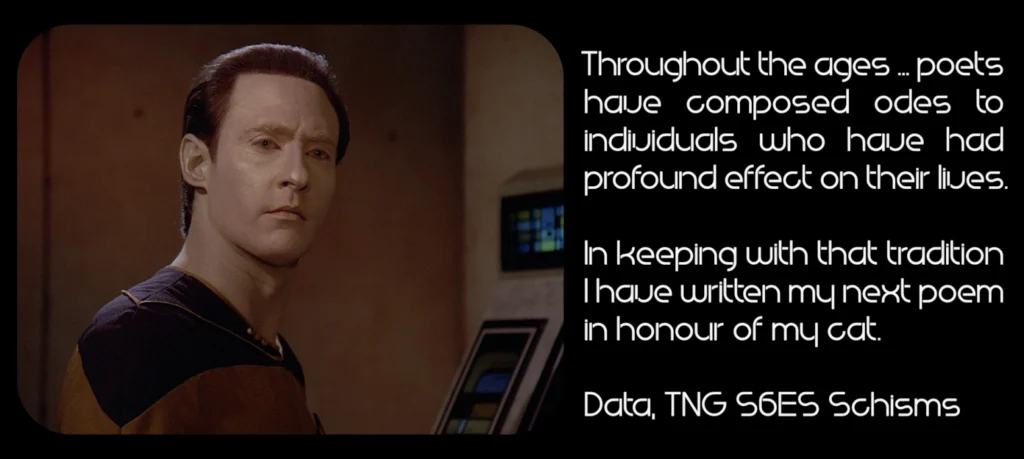
Data from TNG standing in front of computers, he's looking just off from the camera. Text to the right reads: Throughout the ages ... poets have composed odes to individuals who have had profound effect on their lives. In keeping with that tradition I have written my next poem in honour of my cat. Data, TNG S6E5 Schisms

Written by Kelly Whyte. Find Kelly on RPGTrader, itch.io, and DriveThruRPG


I was a late convert to Star Trek. I started with Deep Space 9 (DS9) before branching out into the other ‘mid-Trek’ series, including The Next Generation (TNG) and Voyager, and occasionally into New Trek, like Discovery or Lower Decks. There’s a lot of Trek, and while I vigorously fight being labelled a Trekkie, I probably should give in to the inevitable at this stage.


TNG is, for better or for worse, the definitive Star Trek series. It is dominant in the public consciousness, rivalled only by the original series, and almost all subsequent entries have been, in one way or another, a rebuttal to or continuation of TNG. DS9 was the dark underbelly of TNG’s utopia, Voyager transplanted the ethos of TNG to the frontier, even Enterprise tied itself to TNG with its infamous ending. Despite this, there’s been an aspect of TNG, a well-known and often mocked aspect, that tends to be overlooked when we talk about the setting’s utopia.


Ode to Spot

Felis catus is your taxonomic nomenclature,
An endothermic quadruped, carnivorous by nature;
Your visual, olfactory, and auditory senses
Contribute to your hunting skills and natural defenses.

I find myself intrigued by your subvocal oscillations,
A singular development of cat communications
That obviates your basic hedonistic predilection
For a rhythmic stroking of your fur to demonstrate affection.

A tail is quite essential for your acrobatic talents;
You would not be so agile if you lacked its counterbalance.
And when not being utilized to aid in locomotion,
It often serves to illustrate the state of your emotion.

O Spot, the complex levels of behavior you display
Connote a fairly well-developed cognitive array.
And though you are not sentient, Spot, and do not comprehend,
I nonetheless consider you a true and valued friend.

[Editors note: Embedding the video was not working, so please follow this link to get the full experience of Data’s rendition!]


The performing arts occupy a prominent position in TNG. Pick an episode at random and there’s a decent chance that you’ll see the crew rehearsing a play, performing a concert, or reciting poetry. Frame of Mind blurs the lines between fiction and reality as Riker descends into the world of a play he’s rehearsing. Data’s poetry night is the intro of the suspense episode Schism. Riker’s struggles to play the fictional song Night Bird on his trombone are part of the episode Second Chances; his struggles with the Chet Baker song Night Bird are sadly undocumented. 


Despite the ubiquity, it’s only occasionally that these performances command the A-, or even the B-plot of an episode.The works portrayed tend toward the classics (Shakespeare, Sherlock Holmes, Beethoven, Bach, etc.) for the simple reason that they’re in the public domain. Don’t worry, hold your high-school English class flashbacks; it’s not the content I find aspirational but the crew.


None of the TNG bridge crew were ever professional performers, for whatever utility the word ‘professional’ has in a post-scarcity utopia. Yet most of them take turns performing whatever talents they have and the reaction of their crewmates is almost uniformly positive. It is not uniformly uncritical however; in Schism, for instance, Geordi outlines to Data where his poetry comes up short and how he might improve, Crusher pushes Riker hard in rehearsing his part in Frame of Mind, and Picard’s critique is invited as Data seeks to understand Prospero in Emergence. The feedback is never given unkindly, but honestly when it is invited.


For us poor fools not yet living under fully automated luxury gay space communism, this strikes me as an aspirational situation. One where we’re not mere ‘consumers’ or critics, but active participants in the arts. So many things in the modern world hold us back from being creative; time, expense, lack of opportunity. These are difficult barriers to remove.


But there is perhaps one that’s in our control, and that’s how we treat those who do take the plunge and show us their art. I’m not suggesting we become mealy mouthed in our critiques, or give harmful tropes a free pass. But rather that we strive to be worthy members of a community that encourages people, regular people, to make, show, and grow their own art.


In the ttrpg space, we’re quite lucky in that our tables are theatres, each of us having the opportunity to be performer, author, audience and designer. To make creative choices, take creative risks, no matter how small. We are moved from consumer to creator, in playful collaboration with other creatives. No matter how proscriptive the system, there will inevitably be some space for the people around the table to create.


In subsequent Trek series, these performances are often absent. DS9 had visiting performers, but it’s rare that the bridge crew put themselves out there. Voyager has some, but there is a mean streak to them, such as when they plot a yellow alert to get out of the Doctor sharing his photography. It suits Voyager’s concept of a divided crew, with its incomplete integration of the Maquis members, or as another reminder of the stresses the stranded crew are under. 


Lower Decks is perhaps when performances are at their next most prominent after TNG, though even then they’re often fodder for jokes at the performer’s expense. Captain Freeman’s scat jazz performances or Lieutenant Bingston’s one-man shows are punchlines, in-universe they are treated tests of endurance and the character’s facade of civility rather than artistic expressions. Entire episodes of Lower Decks are still dedicated to characters’ artistic expression, most notably the Crisis Point episodes, but these tend towards just the small group of main characters, the community element is largely absent. 


While each of these series may have made the right choice for their own stories and tone, they are nevertheless stepping away from the aspirational and towards our mundane reality. We move away from a community of free self-expression and improvement back towards one that mocks and cringes at the imperfect efforts of those around us. TNG remains unique, the only time so far we have seen such an artistic community exist in the Trek universe. Despite its rarity, I personally prefer to think this is the way things are in the broader Trek universe, at least in this period. 


Certainly, the other series have means of the characters expressing themselves; Pike and Sisko do so through cooking, O’Brian and Bashir explore holodeck programs together, and one of the best episodes of DS9 has the crew bonding as a team over baseball. I don’t mean to discount those or suggest they have no importance for the characters or the audience. But TNG’s focus on the performing arts is the one that best exemplifies a vision for a place for creative community in humanity’s future.


Transporters and warp drives might be out of our reach for the time being. But we relate to the arts, to performing, and to the people who perform are already within our control. For all of us who enjoy Trek and want to see its utopian vision become a reality, this is a step we can all take.

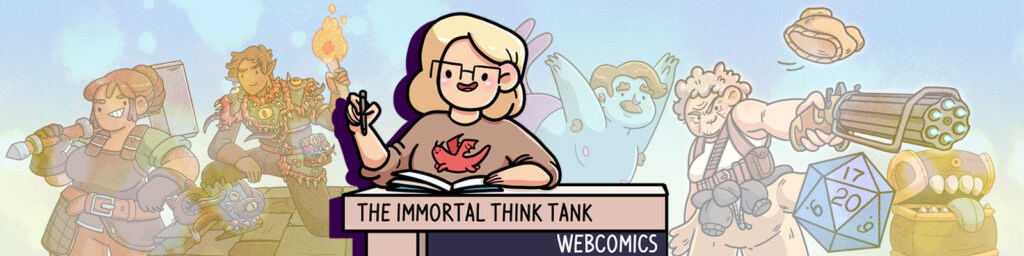
A banner image with an artist sitting at her desk and drawing in a sketchbook, under which reads "The Immortal Think Tank Webcomics." Behind the artist is some of the art she's drawn - a dwarf blacksmith with a hammer on her shoulder, a half-elf adventurer with mimic armour, a male merperson with blue skin and a purple tail, an elderly lady shooting a steampunk styled gun, a d20, and a plushie mimic chest.

Written by Ché Crawford, who draws comics as The Immortal Think Tank. You can support Ché on Patreon.


The Foundation

One of the earliest memories I have is of five year old me being banished to the school library by an overwhelmed teacher because I couldn’t remember the word ‘it’ every time it was my turn to practise reading with her. Feeling for me, the librarian offered to read any story of my choice, and I chose the Brothers Grimm Cinderella – Aschenputtel. 

For those that have never had the pleasure of reading this version of the fairytale, it has many excellent and gruesome moments left out of its later iterations. The stepsisters cut off their toes and heels to fit into the slipper, blood drips from the shoes, and the happy ending was poetic justice unlike any little me had ever heard before – Cinderella’s magical doves tear the eyes out of those black hearted stepsisters, permanently blinding them! It was brutal, it was beautiful, and five year old me was enraptured. 

Stories were always encouraged at home. Over the years I was fed a steady diet of Greek mythology, Christian bible stories, and epic fantasy. Basically anything I could get my hands on to satiate my hunger for adventure. Stories were and are wonderful, and I vividly pictured myself there, battling alongside my favourite heroes in the name of all that is good and right. I developed into an idealist who firmly believed that humans at the core are good, and stories are what connect us. 

And I also developed into a bit of a dreamy, quiet, overthinker, that helped to cement me as ‘a bit of an odd one’ at school. But I didn’t mind. I just set out to collect others like me – the artists, the writers, the anime watchers, and I created a little, happy, creative bubble of friends to do school with. We drew, we wrote, we learned instruments, and I decided that whatever I did in the future, it needed to involve being surrounded by friends like these, telling stories in some form or another. 


Discovering Role-Playing Games

After a year of literature at Waikato University, I came to realise that I didn’t like telling stories with only words. I loathed riffling through my brain to describe what I pictured as a picture. Rolling green mountains, trees heavy with dew – yuck. I saw pictures, I needed to draw pictures. So, unable to find a course that was both writing and drawing, I packed myself off to Auckland to attend Freelance Animation School. 

There, I learned the foundations of drawing. I ‘leveled up’ to no longer drawing a person in a T pose. But it was an animation school, and the focus was on how to tell other people’s stories, frame by frame. I wasn’t in the writer’s room, involved in weaving the story together. I couldn’t even see the story. In front of me was 200 frames of a character slightly moving across the page. But moving where?! Doing what?!

Frame after frame, my brain grew weary. I was a machine, and the human aspect of telling stories was being kept from me, just out of reach. I wasn’t okay with that! But also I’d loaned thousands of dollars to be there, so I wasn’t about to skip out.

Determined to find some kind of adventure, I decided to drag a couple of new friends up to a group at Auckland University that I had heard about, the Auckland Roleplaying Guild, where my first interaction with a roleplaying game was not at the table, but was as a vampire in a live action roleplaying game. I found LARP, and it was brilliant. 

For the first time in my life, I wasn’t reading the story, or watching it, or writing it. I was in it. And I never wanted to leave. 

From there came Dungeons and Dragons, came people’s homebrew worlds, came Shadowrun. I was no longer reading Gandalf subtly working magic, I was Gandlf, not at all subtly working magic, and yes, it was me that set that flour mill on fire, accidentally doing significant damage (and some death, oops) to my fellow party members. 

I quested, I leveled, I got loot. I was good, I was bad, I was all shenanigans. And I knew, for the rest of my life, that roleplaying games would be important.


TTRPG Art 

I don’t know about you, but when I picture TTRPG art, I see art like what’s on Magic the Gathering cards. Beautiful, semi-realistic fantasy paintings, the kind that take years to learn how to do. But I hadn’t spent years learning how to paint like that, I’d spent years learning how to draw and animate funny little cartoons. 

And could I learn to draw like that? Possibly. But did I? No, not at all. Cartoons are fun. I like the silly shapes, the flaily limbs, the leaving off noses if I don’t feel like drawing them (which is almost always). I didn’t have an extensive portfolio of paintings to apply for jobs with. And because I’d seldom seen cartoons featured in TTRPG or fantasy books, I assumed that working professionally in that world was out of reach for me.

What I did have though, was a group of friends who came over to my house weekly for table top games. 

In my opinion, one of the best parts of playing table top roleplaying games is the community that can come with it. There’s a real sense of achievement when you down a big bad guy as a group. It bonds you in ways that are harder to notice in real life. “Good job, we both made enough money to pay our rent this week,” doesn’t quite feel as epic an achievement to bond over as “we saved the underdark from The Demon Queen of Fungi after months of questing together.” 

But it was much to my surprise that my favourite moments of these weekly games weren’t so much the epic adventures I always dreamed of going on. My favourite moments were the funny little shenanigans that happened around the table between my friends. I was desperate to never forget the silliest things we got up to. And also, in the back of my mind, I’d been wanting to draw out a fantasy graphic novel, but wasn’t happy with where my ability to draw was. Two birds with one stone, I’d practise and get better at drawing, while turning these moments into little four-paneled webcomics. 

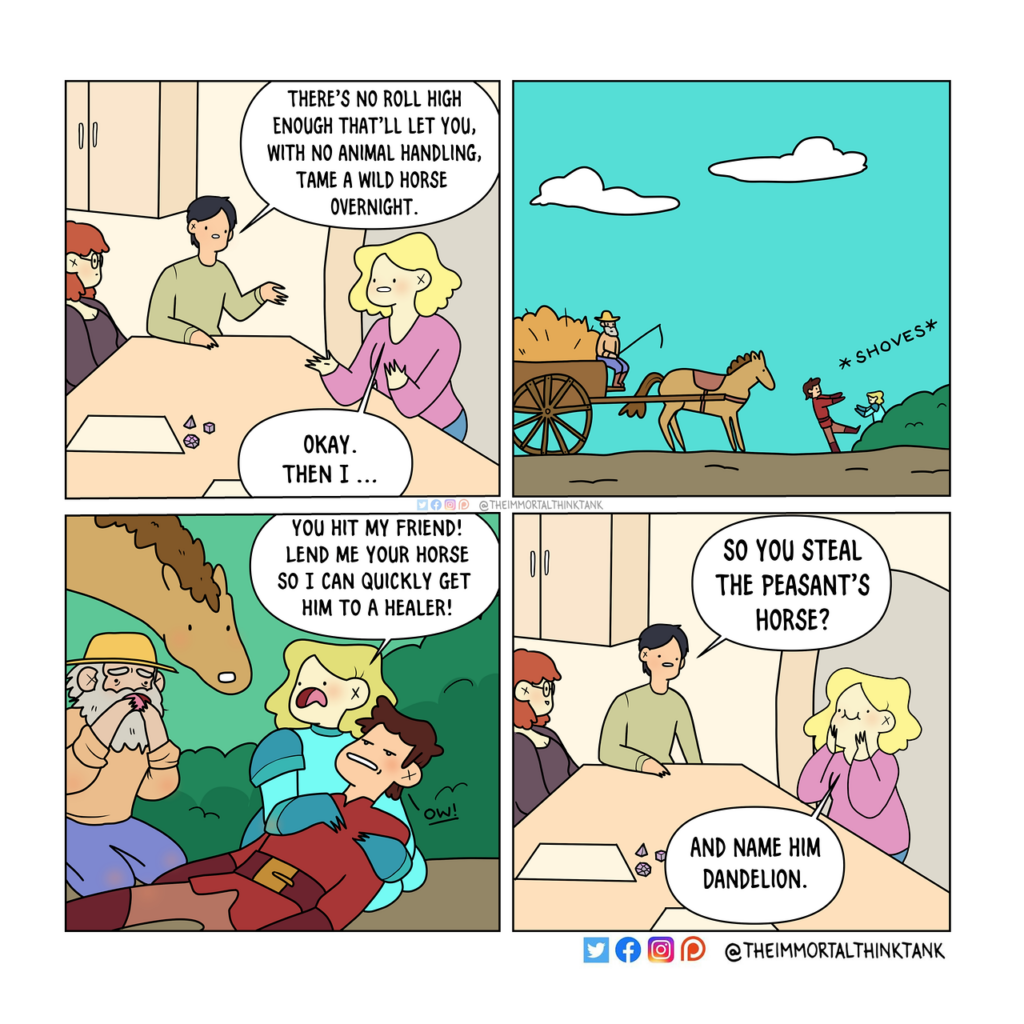
A four panel webcomic. In panel one, three players are sitting at a table playing a tabletop roleplaying game. They have character sheets and dice. 
The dungeon master says, "There's no role high enough that'll let you, with no animal handling, tame a wild horse overnight."
The player responds, "Okay. Then I..."
In Panel 2, the player's character pushes another character in front of a horse and cart being driven by a farmer. 
In Panel 3, the player says to the farmer, "You hit my friend! Lend me your horse so I can quickly get him to a healer!" The farmer and horse look alarmed.
In Panel 4, it shows the players back at the table. The DM asks the player, "So you steal the peasant's horse?"
The player looks pleased, and says, "and name him Dandelion."

From Webcomics to Paid Illustration

It took time, but through posting my comics on various social media websites, in particular D&D focused subreddits, I slowly built an audience that led to being paid to draw. I genuinely never thought I could work as an artist. But I was going to draw and tell stories regardless. It’s who I am. I can’t exist in any kind of happy or peaceful way without stories. 

The work came in stages. At first, the occasional commission for character art. It is always fun (although time consuming) to help a player bring to life their character visually. Patreon was the next step, then ad revenue on webtoon and facebook. They were all little amounts, but they can add up when you keep going steadily. 

But I am also a firm believer in asking for what you want. And one thing I wanted was to draw some comics for the sketch comedy group Viva la Dirt League. Their sketches were gaming shenanigans brought to life. 

They’re also evidence of what could happen when you just do the thing you want to do. No acting work? Create your own. Not many cartoons in the TTRPG world? Draw TTRPG cartoons anyway. I felt like we’d be a good match.

Viva la Dirt League was going to have a panel and signing at Auckland Armageddon. I remember asking a friend if it would be ‘cringe’ for me to turn up at the signing table with cartoons for them. I don’t remember his exact advice, but I’m pretty sure it was along the lines of ‘just be cringe then.’ So I went, I met them, I gave them art. Was it cringe? I don’t know. But they gave me a tour of their very cool studio and a commission for 20 comics based on their Epic NPC Man series. Twenty comics in my cartoony style. 

Che Crawford

Attachments6 Jul 2026, 14:11 (2 days ago)

to me
Hiya

Absolutely! I've popped them into a ZIP folder. They're named Banner, then image 1, 2, 3 etc, in relation to the order they show up in my post. 

I'm glad the blog post read okay. It occurred to me about one sentence in that it's actually been a while since I've written anything with so many words, haha. I wasn't sure if it made sense, and if the tone of it all was okay. I do really want to inspire more artists to pursue doing art for TTRPGs though. So often we see that one (very cool) high fantasy type art in ttrpgs, but I think just as we can have all kinds of games, we can have all kinds of art. So I'm glad it comes across as somewhat encouraging etc. 

I've done my best with Alt Text but I dunno what I'm doing really 😆 Hopefully it's okay. 

Alt Text

Banner
A banner image with an artist sitting at her desk and drawing in a sketchbook, under which reads "The Immortal Think Tank Webcomics." Behind the artist is some of the art she's drawn - a dwarf blacksmith with a hammer on her shoulder, a half-elf adventurer with mimic armour, a male merperson with blue skin and a purple tail, an elderly lady shooting a steampunk styled gun, a d20, and a plushie mimic chest. 

Image 1
A four panel webcomic. In panel one, three players are sitting at a table playing a tabletop roleplaying game. They have character sheets and dice. 
The dungeon master says, "There's no role high enough that'll let you, with no animal handling, tame a wild horse overnight."
The player responds, "Okay. Then I..."
In Panel 2, the player's character pushes another character in front of a horse and cart being driven by a farmer. 
In Panel 3, the player says to the farmer, "You hit my friend! Lend me your horse so I can quickly get him to a healer!" The farmer and horse look alarmed.
In Panel 4, it shows the players back at the table. The DM asks the player, "So you steal the peasant's horse?"
The player looks pleased, and says, "and name him Dandelion."

Image 2
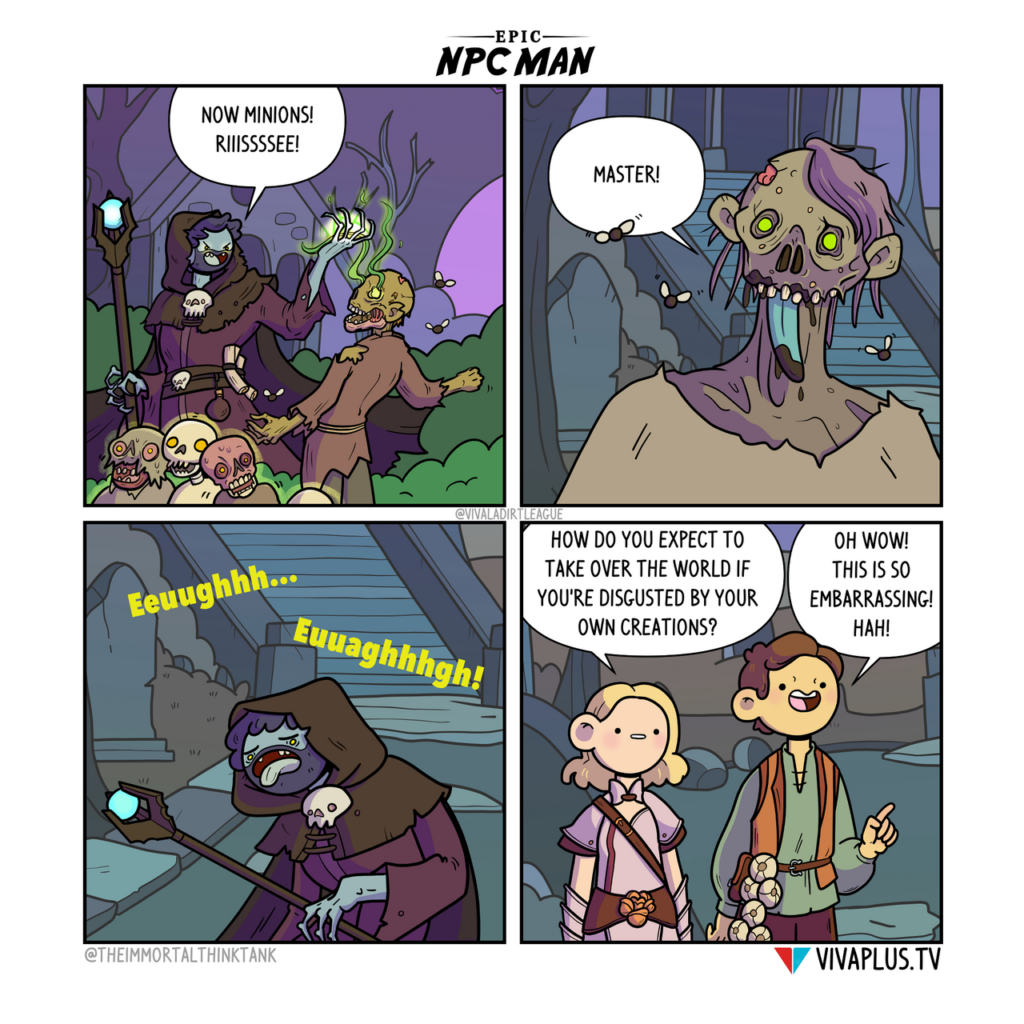
A four panel webcomic based on an Epic NPC Man sketch by Viva la Dirt League. In panel one, a necromancer is in front of a graveyard, using green magic to reanimate several dead bodies. He is wearing a black cloak, has skulls as a part of his outfit, and is wielding a staff. His hand is raised high with magic pouring too and from a rising body. He says, "Now minions! Rise!"
In Panel 2, a zombie missing its jaw, blue tongue hanging long and freely, flies buzzing around it says, "Master!"
In Panel 3, the necromancer gags in disgust.
In Panel 4, there is a woman in white armour, and the NPC 'Greg'. The woman asks the necromancer, "How do you expect to take over the world if you're disgusted by your own creations?"
Greg laughs at the necromancer and says, "Oh wow! This is so embarrassing! Hah!"

 I took this as an open invitation to be a professional TTRPG Cartoonist

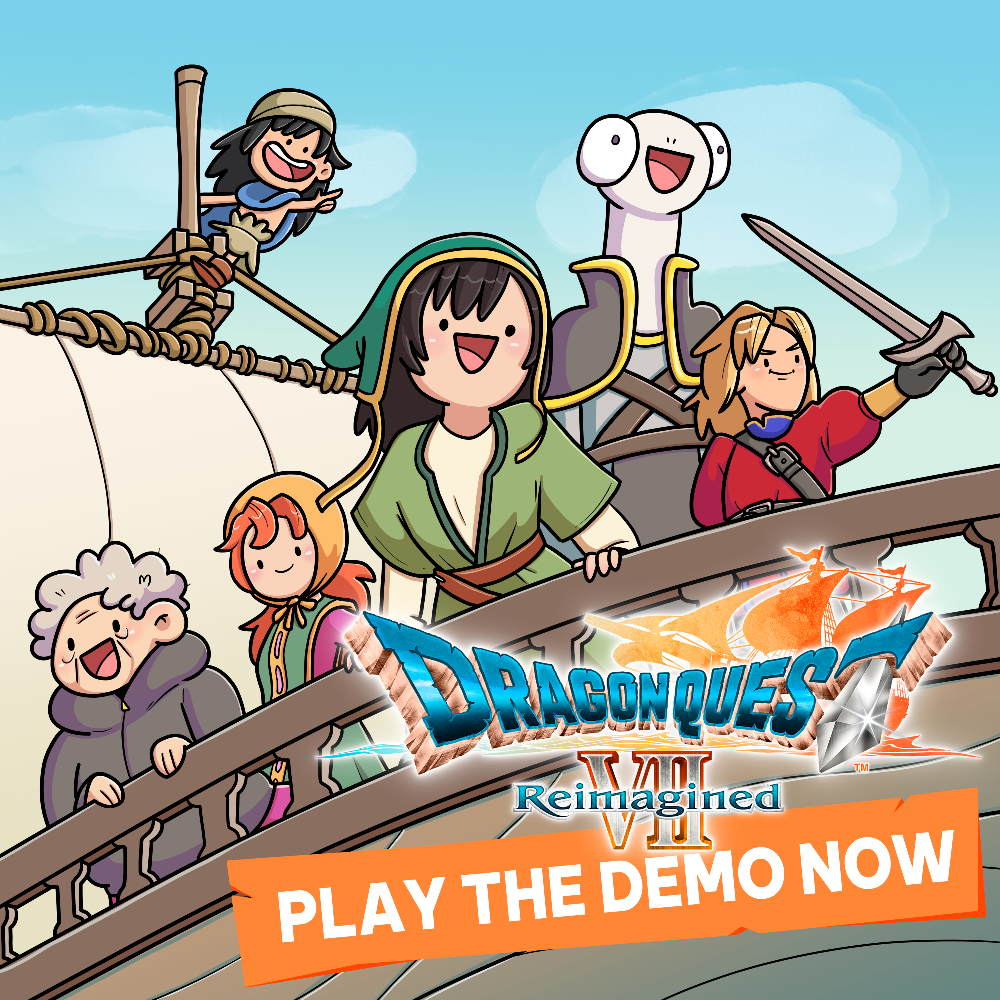
From there, I’ve drawn comic advertisements for Roll & Play Press, book covers such as the one I drew for Dumbest D&D’s Big Book of Little Adventures, and I even got to draw a comic for Square Enix’s Dragon Quest VII Reimagined, featuring my table top characters alongside theirs. 

The image is an advertisement for the remastered Dragon Quest Seven video game. It features a ship with a number of characters on it from the video game Dragon Quest seven, and from The Immortal Think Tank's webcomic Table Top. Near the front of the ship is a boy with shoulder length black hair, green clothing, and a green hat. He is leaning on the ship's rail, looking happily into the distance. Behind him from left to right is an elderly adventurer lady in a black hoodie, a young woman with ginger hair and a yellow headscarf, a tall lizardfolk with pauldrons and a gray robe, and a young man with golden hair, a red tunic, lifting a sword up high. Behind these characters, high up on the ship's mast is a young boy with long black hair pointing into the distance. All the characters look excited.
In front of the image is the text, "Dragon Quest seven reimagined, play the demo now."

There’s a whole spectrum of ways to draw, of stories to tell, of games to play, and lives to be had. So, this is my advice to you. If you want to do something, don’t wait to be invited, just do it. Storm your way through, make what you want to make, and know that whatever it looks like, it belongs. 


Advice for Emerging Artists 

My number one piece of advice is to be reliable. It can be intimidating getting your first commission. You might let the person down. It feels different to draw because you have to, instead of because you want to. Practice on your friends first. Get them to give you a character and draw it up for them on an estimated timeline and stick to it. People who hire artists want to know they’re going to get the art they need, in the time they need it. And once you’ve proven reliable, more work will come. 

Create an audience for yourself. Post to social media, show the world what you do. I am not the best artist. I absolutely know that some of the work I’ve gotten is because of the audience I have on social media. As an artist who draws TTRPG webcomics, I come ready made with the target audience many of the people who hire me are trying to reach. 

Don’t compare yourself to other artists. I believed I couldn’t work as this kind of artist because I drew cartoons. I compared myself to Magic the Gathering cards, to the loading screens on my games, and to the amazing painted illustrations in many of the books we consume. But I could, and you can. However you draw, whatever style, it belongs somewhere. 

And lastly, believe in the power of humans. In the age of generative AI, it can feel like there’s no place in the world for emerging artists. But I believe in you, a human, and what you want to make and share with the world, and so do many others. Our stories and our art connect us. And I plan to fight tooth and nail for creatives to keep creating. I hope you’ll join me in that battle – our epic quest, as fellow creatives. Let’s keep connecting with each other. 

Let’s keep shenanigans-ing. 

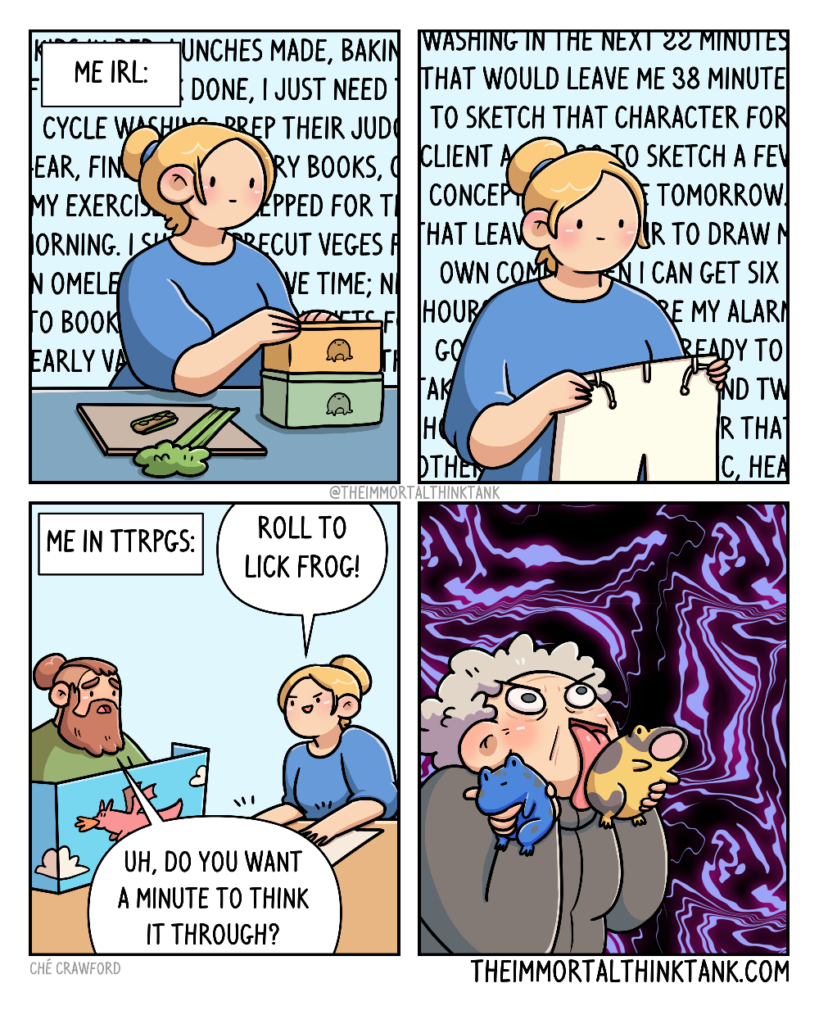
A four paneled webcomic by The Immortal Think Tank.
In panel one, there is a caption up top that says, "Me in real life." The image is of a woman making school lunches for her children. In the background is a wall of text, representing her thoughts. They say things like, lunches made, cycle laundry, prep their judo gear, find library books, precut vegetables, and so on, representing that she has a constantly running to-do list.
In panel two, she is holding up the judo pants she needed to find. Behind her are more scrolling thoughts such as, if I fold the laundry in the next 22 minutes, that would leave me 38 minutes to sketch that character for the client. It continues on to list more tasks and more time allotments to finish them in, to allow her six hours to sleep, before getting the children up for school, representing how much she's constantly thinking about her daily responsibilities. 
In panel three, the caption up the top says, "Me in tabletop roleplaying games." The image is of a man, behind a dungeon master's board, and the woman from the previous panels, playing a tabletop game. The woman says, "Roll to Lick Frog!" The dungeon master, looking concerned, asks, "Uh, do you want a minute to think it through?"
In panel four, an elderly woman, representing the character the woman plays in her game, is enthusiastically licking toxic looking yellow and blue frogs. The background has jagged purple lines swirling around, representing the impending hallucinations the character might suffer.

A crest with swords behind it and a banner saying 'AJ Pickett' on it, over an image of trees.

Catch AJ on the Makers of Actual Plays panel, along with Vahid Qualls (Dice Legenz), Julz Burgisser (Fate of Isen), and hosted by Sero (Redgate & Wolf), on the KiwiRPG Twitch channel, at 7pm-9pm Wednesday 8th July / Wednesday 8am BST / Wednesday 3am EDT

Written by AJ Pickett. Find AJ’s youtube channel here.


Most advice about YouTube monetization is built around the news cycle: post fast, ride trends, chase the algorithm’s mood this week. I went the other direction. My channel covers Dungeons & Dragons lore and mechanics in long-form, deeply researched videos, and the entire foundation of my income is built on one idea: make reference material, not content.

The difference matters more than it sounds. A trend video earns most of its revenue in the first 72 hours and then dies. A reference video — something people search for, bookmark, and return to — keeps earning years after you hit publish. My channel’s lifetime ad revenue currently sits north of $470,000, and the majority of that wasn’t built by any single viral hit. It was built by an archive.

Here’s how that actually works, and how another creator could apply the same logic outside my niche.

Build things people search for, not things people scroll past

The single biggest decision I made early on was to treat each video as a permanent resource rather than a topical post. Titles like “The Complete Guide to the Gelatinous Cube” or deep dives into specific D&D lore aren’t designed to catch a wave of interest this week. They’re designed to be the answer when someone searches that topic next year.

This only works if the content is actually comprehensive and accurate. A shallow “complete guide” gets discovered once and abandoned. Mine pull from primary sources, cover every edition or variant of a topic, and genuinely try to be the most useful video on the subject that exists. That’s slower to produce, but it’s the entire reason the content keeps earning.

Let the archive do the recruiting

Individual videos don’t build a channel. The archive does. Once you have enough comprehensive, well-made videos covering an entire subject area, YouTube’s recommendation system starts doing your marketing for you — pulling new viewers in from related searches and suggested videos, video after video, without any extra promotional effort on your part.

On my channel, new viewers consistently make up roughly half of monthly viewership, well ahead of returning regulars. That’s not because any one video is going especially viral right now. It’s because the catalog itself has become wide and deep enough that there’s always an entry point for someone who didn’t know the channel existed yesterday.

This is the compounding effect that separates reference-content channels from trend-chasing ones: every new video doesn’t just earn on its own, it also makes every existing video slightly more discoverable, because it adds another thread into the recommendation web.

Consistency is the unglamorous engine

None of this works without consistent uploads over a long period. It’s tempting to treat consistency as a vanity metric — something the algorithm “rewards” — but the real reason it matters is more practical: a thin catalog can’t generate the recommendation density that drives new-viewer discovery. You need enough comprehensive videos in the archive before the compounding effect kicks in, so, don’t give up your day job until you are earning more than your paycheck.

There’s no shortcut here. The channels that make this model work are the ones that show up reliably for years, not the ones that post in bursts. There is a huge attrition rate of creator burn-out, it requires self discipline and sacrifice. I don’t watch TV, I rarely play video games, I have almost no time for recreational reading. I often joke that I am the worst boss I have ever had. You have to manage your diet, get exercise, know when to push it and when to give yourself mental health breaks. Learn what motivates you and build good habits into obsessions. My brain is the source of my income, I treat it like a work horse.

Reputation is a monetization strategy, not just a branding nice-to-have

Being known for accuracy and depth in a niche is itself a growth lever. Once an audience trusts that your content is well-researched, they treat your channel as a default source for that topic — which means they’re more likely to click on a new upload immediately, comment, and return for future videos. That trust also tends to attract viewers from outside the immediate fanbase who land on a video through search and stay because the quality holds up.

This is compounded by direct interaction with commenters. I read every comment, I respond to a lot of them. This not only turns casual viewers into regulars and regulars into advocates, it also fights negative comments and trolling, because the root cause of a lot of people’s trolling is that they are seeking attention, so, once they realize you are going to give it to them, and they don’t have to be so aggressive about it, it can transform them into very dedicated fans, because you satisfy their craving for validation as a person

Be honest with yourself about the ceiling your niche puts on you

This is the part most “how I make money on YouTube” posts skip, and it’s the one I think matters most: your income is never fully decoupled from the popularity of your niche. My channel’s revenue arc closely tracks the broader rise, peak, and cooling of interest in D&D lore content as a category. I didn’t do anything wrong when growth leveled off after its peak years — the macro interest in the niche shifted, and no amount of personal consistency fully insulates you from that.

Older videos can keep earning steadily even once the niche cools, because the reference-material approach means your content isn’t dependent on being “current.” But it doesn’t make you immune to the category-level tide. Plan for both the upside and the eventual leveling out.

The model in short

If you’re trying to build durable income on YouTube rather than chase a single viral hit, the strategy that’s worked for me comes down to a few unglamorous, repeatable choices: make videos that function as reference material rather than disposable content, commit to comprehensive coverage of your subject area so the archive itself becomes a discovery engine, post consistently for long enough that the compounding effect has time to work, build a reputation for genuine depth and engage with the people who show up because of it, and stay realistic about the fact that your niche’s broader popularity will always be part of the equation.

None of it is fast. All of it is replicable.


AJ Pickett is the creator behind a long-running YouTube channel dedicated to Dungeons & Dragons lore, mechanics, and worldbuilding, known to his audience as the Mighty Gluestick or the Sage of Candlekeep. He produces deeply researched, long-form videos covering monsters, rules history, and lore across every major edition of the game.

A screenshot of a youtube channel titled AJ Pickett, showing a number of videos about Dungeons and Dragons lore and monsters.

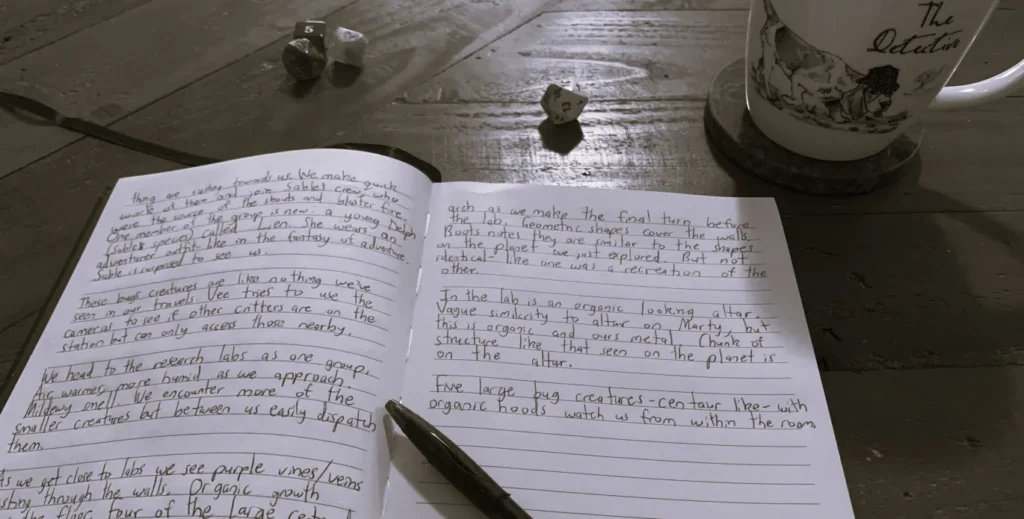
A picture of a notebook with notes from a solo rpg playthrough written in it, and a pen laying on top.

Catch Sam along with Sero making a solo rpg live on stream, as a part of KiwiRPG Week 2026 live on our Twitch on Tuesday 7th July, 1pm-4pm NZST / Tuesday 1am BST / Tuesday 8pm EDT. The VOD will be linked here after the panel.

The game they create will be played by Ruby on stream later that day, at 6pm-9pm NZST / Tuesday 7am BST / Tuesday 2am EDT.


Kia ora! My name is Sam, and I’m here to talk about solo roleplaying games.

What springs to mind when you hear the phrase ‘solo roleplaying game’? For some, solo journaling games occur first. Others might think of adaptations of popular games like Dungeons and Dragons and Pathfinder, where roll tables and oracles are used to simulate playing with a GM. Whatever springs to mind, there is no one right answer. Like the broader tabletop roleplaying label solo roleplaying games (called ‘solo rpgs’ for short) cater to a range of player tastes.

Journaling games encourage players to sit with their thoughts and explore a character in a way not easily achieved in a group setting. Cassie Mothwin’s Tangled Blessings generates story prompts with tarot as the player looks back on years of magical studies. Two Graves by our own Oru Games uses both dice and playing cards to explore a quest for vengeance, from the inciting incident to the act of revenge. The recently released Pride & Putrefaction by gothHoblin (Emma Grier) incorporates coins as well as dice in guiding the player through a romantic period drama full of zombies. Although overall lighter in tone than those previously mentioned, topics like death and helplessness still hit where it hurts at unexpected moments and encourage a pause for reflection.

Not everyone enjoys writing exercises. Other gamers chase the experience of exploration and adventure found in many group tabletop experiences. While adaptations of multiplayer games exist, other adventurous experiences were created specifically with solo gamers in mind. Shawn Tomkin’s Ironsworn is the classic example. In Ironsworn, players roll dice to explore the land, overcome obstacles and even assess how well they are pursuing their titular iron vows. In my Ironsworn chronicle, my character had vowed revenge on the father who left her for dead. While interrogating her uncle about his whereabouts, the dice were not in her favour and she ended up killing him.

If I was writing a story on my own, or even journaling in response to a prompt, I probably would have introduced a less disruptive complication. Ironsworn is the closest experience I’ve found to the surprise twists and turns experienced in a multiplayer game, but it’s far from the only one out there. As of writing, RPG Trader alone lists 380 entries under the ‘solo’ tag, while on Itch the ‘solo rpg’ tag has over 6000 entries. There’s something out there for everyone and it’s worth taking the time to browse and see the breadth of experiences on offer.

Maybe you’ve already played a few solo rpgs and are hungry to emulate a particular experience. This is where the Solo RPG List comes in handy! This is an incredible resource for finding solo (and two-player) tabletop games. It’s easily filtered by your favourite tags. Are you like me and constantly looking for more vampire games? Did you enjoy Ironsworn and want to play more games based on that system? Type in your desired keyword and browse the results.

Do you have a favourite solo rpg? Did a solo rpg experience touch you more than expected? Shout it out below! In this case, there can never be too much of a good thing.

-Sam

The words 'd12GO!' and 'The universal RPG' over a pink sky with the tops of pink mountains.

Catch Brad running a game of d12GO! as a part of KiwiRPG Week 2026 live on our Twitch on Thursday 9th July, 6pm-9pm NZST / Thursday 7am BST / Thursday 2am EDT. The VOD will be linked here after the panel.

Designer Brad Zimmerman leads a game of the flexible and fun d12Go. A completely randomly-rolled game: what will the dice bring, and how will a team of brave players handle it?


Hey there, Kiwi RPG folks!

My name is Brad and I am the creator of a game called d12GO! The elevator pitch for d12GO is that it’s a universal system for running roleplaying games in any genre or setting, without having to spend a lot of time learning new games for each.

For this reason, it has been used by a lot of people who want to play a quick one-shot session, with minimal prep.

I love running improvised game sessions, but I also understand that these can be very daunting, especially for people who usually run pre-written modules or supplements and aren’t used to stretching their improv muscles.

In this post, I thought I would whip up a few things I’ve learned about running unprepped one-shot games, that hopefully you may find useful.

Once the group has decided on a genre and a system (e.g. playing a “Teen Detective Story” using “Monster of the Week” by Michael Sands, etc.), whip up some characters, then jump into the below steps.


1. Outline the Story Together

Ask the players for ideas about things to include in the story (unless you already have a pretty firm idea yourself). Maybe you’ve thought of WHAT is happening, but not WHY it’s happening or WHO is behind it. The players are just as responsible for worldbuilding as you are, so don’t feel like it’s all on your shoulders. 

Scribble down a few brief notes (for yourself), describing:

  • Where a story like this would likely start
  • What kind of events might take place in the middle
  • What the climax may look like

It’s important to remember that everything you outline for an improvised game can be vague and unpolished. Nobody in your group expects perfection!


2. Make Quick Character Intros

Longwinded character explanations and backstories are great when you have a whole months-long (or years-long) campaign ahead of you. But in a short game, they only serve to slow everything down and chew up valuable time at the table. 

Get the players to describe:

  • One or two key points about their character’s outer appearance
  • One or two key points about their behaviour or motivations
  • Whether or not their character is prepared (physically or mentally) for the situation


3. Lock in a Firm Starting Point

Once everyone knows who they are and how their character behaves in the game world, put all the player characters into the same place, with them already informed about the “main situation” of the story.

I’ve made the mistake of letting characters “find their own way to the story”, which resulted in a “one-shot” that lasted 8 sessions… I won’t make that mistake again and I hope you don’t either!

A good idea is to summarise to the players:

  • What the main situation of the story is (e.g. “The local theme park is under attack by what reports are suggesting is an army of mutated pumpkins”)
  • Then tell them exactly where they are (e.g. “You are standing together in the parking lot, as parkgoers flee all around you”)


4. A Call to Action!

From the established starting point, get the story underway immediately, by forcibly hurling the characters into the fray with a call to action

Depending on the type of story, this could take any number of forms, including:

  • An innocent NPC pleading for help (either face-to-face or via a remote means)
  • Signs of an impending disaster (e.g. a rapidly spreading fire, a falling tower, a space station plummeting towards a planet, etc.)
  • A hostile creature chasing them into danger
 
5. A Low-Stakes Challenge

Get the players rolling dice as soon as possible, but keep the stakes relatively low for this first outing. 

This challenge may be something like:

  • A social encounter (e.g. convincing someone to give you access to a location or resource, etc.)
  • A physical obstacle (e.g. a precarious rope bridge, a vine-covered rock wall, a locked mansion gate, etc.)
  • An easy combat situation such as goblins or minion-level creatures of some kind.

Ideally, overcoming this first challenge should grant the player characters access to a new location, a valuable resource, or more information about what’s going on. 


6. Check Back with the Players

This is something you can do at any time during the game, but it’s good to get a gauge early on (especially if the first challenge was harder than intended).

Ask how their characters are feeling about the situation that is unfolding. This might help you flesh out the remainder of the story. Maybe they’ve got theories or ideas you never even considered.

Ask them if their characters want to rest, gather resources (e.g. ammunition, safety equipment, transportation, etc.) before continuing.


7. A Medium-Stakes Challenge (and a twist?)

When they’re ready, prompt the players to keep moving further into the situation, to the next significant location or point of interest.

There, they should come upon another challenge. This should be noticeably more difficult than the last one, and ideally require a different skillset or strategy (i.e. don’t make this just a harder version of the first challenge).

This is also a great time to add a little (optional) depth or intrigue to the story by throwing in a twist or unexpected complication.

Some ideas for a twist/complication could be:

  • The person or organisation that sent you here was actually trying to get rid of you
  • The main antagonist is revealed and it’s someone from your past
  • A tool or useful resource suddenly stops being useful (either because it’s broken or the problem adapts to make it redundant)
  • The true scope of the situation is revealed and it’s not what you had assumed (either it’s much larger or much more isolated than anticipated)
  • An assumption you made about the situation turns out to be completely wrong

The medium-stakes challenge (and twist) should reveal the narrative path to the final confrontation. This may be a literal path (like a mountain pass or broken trail deep in the jungle) or a guaranteed sequence of events. 

Either way, the endgame should be apparent to the players by now, but they must be given time to prepare, instead of being forced directly into it.


8. The Climax

The climax of the story is heavily dependent on the type of story you’re telling, but may be:

  • A boss fight. This could be a singular powerful enemy, or a large group of enemies that need to be defeated or overcome. In either instance, it should be more difficult than the medium-stakes challenge, and the players should be made very aware of that fact. 
  • A large-scale disaster (e.g. a nuclear reactor counting down to explosion, a dam bursting, a high-speed chase, a thrilling escape scene, etc.)
  • A very difficult physical obstacle to overcome (e.g. climbing an icy cliff while being bombarded with attacks from above, piloting a malfunctioning spaceship as it hurtles towards a city, etc.)

Whichever of these climaxes your game includes, try to incorporate multiple phases to add depth and get the players to try out different skills. 

For example, the boss fight could start with weak enemies that are only trying to slow you down while the big bad gets ready. If the players somehow manage to circumvent the weaker enemies, reward them by letting them know the big bad isn’t at full strength. 

Or the nuclear reactor escape requires a set of keys in order to get to the outside (fetch-quest-style), and then you enter the fleeing phase. 


Important Things to Remember
  • The entire point of the game is to have fun. You know this, and so do your players.
  • Checking in with your players for ideas is always valid. This can be especially helpful with fun little details that don’t really affect the story (e.g. “There’s a person cornered by the monster and screaming for help. What does this person look like?”)
  • Drawing inspiration from existing media is absolutely fine. If you want to take some plot points from The Terminator or Power Rangers or Dragonball Z, no one will stop you.
  • Say “YES” more than you say “NO”. Obviously there will be times that a no is required, but if you err on the side of yes, your players’ ideas will help create something truly unique and memorable.
  • A one-shot game means there is no larger narrative at stake. You don’t need to worry about accidentally setting up a huge problem later on because THERE IS NO LATER ON.


So, yeah, those are my thoughts about running improvised one-shots. Please remember these are opinions based on my own experience and will almost certainly be contentious and downright incorrect to some game masters. 

Regardless, I hope you can take something useful away from this and go have some fun.


SUMMARY
  1. Outline the Story Together
  2. Make Quick Character Intros
  3. Lock in a Firm Starting Point
  4. A Call to Action!
  5. A Low-Stakes Challenge
  6. Check Back with the Players
  7. A Medium-Stakes Challenge (and a twist?)
  8. The Climax


Thanks for reading!

Brad Zimmerman


Watch d12GO! as an actual play stream, Thursday 9th July: 6pm-9pm NZST on KiwiRPG’s Twitch.

The words 'Tales from the Table' in white text and a deep black shadow, over a picture of a campfire.

Catch Rave running a session of her game ‘Tui: Birds of a Feather’ as a part of KiwiRPG Week 2026 live on our Twitch on Monday 6th July, 7pm-10pm NZST / Monday 8am BST / Monday 3am EDT. The VOD will be linked here after the panel.

Prepare yourself for shenanigans with one of Aotearoa’s native bird species. Tui are known for three things – song, style, and rage. The newest crew in the tui mafia are looking to make a name for themselves, and maybe score some points with the Dui.

Written by Rave, who writes games as Wayward Masquerade. Find her game Kea: Mountain Trolls here.


Awakening

One of my all time favourite memories of tabletop gaming was played without a tabletop.

RPG Alley: a space filled with the clatter of dice, the rustle of paper, and the buzz of a dozen stories unfolding at once.

We are overrun. The GMs on shift are running games, the surge GM is running games, the shift manager is running games. We’re out of GMs, hell, we’re out of tables. Fortunately we are not yet out of snacks.

In walks a man. Hiding behind him is his daughter. Kiddo is knee high to a grasshopper, peering around her dad with wide eyes. They want to try a game. In the background, someone rolls a crit and a cheer goes up. I look around, spot a bit of clear floor, dig through my game folder, pull out “Three Goblins in a Trenchcoat” and snag one more player.

Sitting cross legged, armed with pecils, paper, and D6s, we begin. My goblin games usually start with a comically badass matriarch giving a mission to three hapless goblins who will no doubt engage in hijinks, shenanigans, and various forms of crime. There’s lots of waving arms and voices of varying quality.

Kiddo starts out declaring her actions by whispering them to her Dad, who relays them to the group.

 They track down a human mage, and here’s where I make the first (best) mistake. I let the goblins see the fireball staff in the mage’s hand. One bad roll later, it’s a *malfunctioning* fireball staff, sans one human mage.

Kiddo grabs the staff and shouts “Fireball!”. It might have been the first time she spoke directly to me. I roll to see how bad it’s gonna be. They accidentally blow up the human town. Whether this is a net positive remains to be seen.

After a judgmental stare from a singed sheep in the feild where they landed, the goblins make their way back to the goblin town, situated in a series of caves. Every obstacle, every challenge, every *polite greeting* is met with a shout of “Fireball!” and a variety of magical mishaps. Kiddo is now half standing up, defiantly raising an imaginary staff and cackling at the destruction she was wrought. The rest of the group has accepted their new flame lord. Her Dad is trying to decide if this is a good thing or a bad thing.

Finally, they meet the Matriarch. The delicate art of diplomacy is deployed by way of “FIREBALL!”.

There is a battle, and the dice do what dice do. True to form, our goblins blow up the goblin town, riding a column of fire to the surface, which now resembles a volcanic eruption rather than the gently rolling hills of just a moment ago. They crash into a narratively convenient body of water a ways off.

Hijinks – Check

Shenanigans – Check

Explosions – Definitely Check.

A final scene where kiddo’s fire lord rises from the water, and burns herself a permanent place in my catalog of inspiration for future villains – Check.

All players agree, a job well done. The faithful pay homage to the tiny avatar of fire and murderhoboing. Across the gaming world, a disturbance is felt in the aethyr. A murderhobo has awakened.

Kiddo found the spark, and she used it to barbecue a significant portion of an imaginary land.

I’m so proud.


Find 3 Goblins in a Trenchcoat here

The words “TTRPGs Are Just Pōwhiri” beside a drawing of a figure with pink hair spray painting the words “F**K OFF”

Catch Iwā running a session of her game ‘Yous are Broken Too?’ as a part of KiwiRPG Week 2026 live on our Twitch on Saturday 4th July, 1pm-4pm NZST / Saturday 1am BST / Friday 8pm EDT. The VOD will be linked here after the panel.

Telling a story of the story of how even when broken, we can find connection and meaning. Through narrative based discussion, “Yous are Broken Too?” guides the players through complex themes, and seeks to understand them from a holistic indigenous perspective.


This blog post uses te reo Māori throughout. There’s a glossary at the end, or you can find Te Aka Māori Dictionary here.


It’s a wild idea, that something so mechanical, western, and focused on entertainment can emulate something so ancient and cultural. But it can. Because while pōwhiri are super cool and cultural, they’re not ancient; culture evolves, shifts, and is fluid. Culture is meant to change with the times. Its meant to grow with those it is intended to be used by. As a takatāpui Māori wahine, its difficult for me to not embed myself and my people in the games I play and create. So when I play D&D, yeah for sure, it’s a Māori game just for the simple fact that I am Māori and thus everything I do is Māori. But the idea I’m attempting to posit is that the whole structure of TTRPGs as a whole is as ancient as any form of story telling that has ever existed, we just took the tried and true formula and added dice.

During a pōwhiri, there are multiple stages, each one dedicated to a different bit of the welcoming ceremony, each one existing in a different bit of Te Ao Māori. And like a pōwhiri, the TTRPG tables are the same; there are different parts to the structure that guide the flow of play. To explain everything, I’d need to write a whole new masters thesis, so I’ll only cover a few pieces of the overall puzzle; just the parts that sing out to me most as a GM.

Part one: The Carpark.

The Carpark exists as a funky new space. It never really existed until recently when communities became less of a group that traveled around together. In western society most people live individual lives, and arrive separately as opposed to the old days when we wandered around as one big group. In the old days, prior to arrival at a marae, you could talk at length about who does what during whatever part of the pōwhiri, cause you had the time. In our modern day, sometimes there just isn’t time, or sometimes the aunties aren’t on facebook or whatever, so the only opportunity to actually discuss what to do is the twenty minutes before you step through the waharoa; the time you spend in the carpark. It shows a certain level of cultural competency, to rock up on the day and be able to decide which of those gathered has the most mana? Who can karanga or whaikōrero? It takes a lot of courage, confidence, and knowledge to just wing it and decide twenty minutes before go time who the heck can lead you in a badass as hell ritual.

Some people think pōwhiri are boring, they just don’t know whats going on though. Cause if they did, theres no way they’d think that. Imma explain it to you.

Let me preface this: a lot of what I’ve learned I’ve learned from various aunties and uncles, from various visits to various marae. A lot of what I’ve learned is anecdotal, unique to myself. So my specific understanding, as well as everyone’s understanding of Te Ao Māori, is unique to each person. There is no one way, there is no black and white with Māori culture. Māori people are not homogenous, there are so many ways to do things, as long as we respect the whenua we are on, respect the tangata whenua and their ways of being, then we’re doing alright. Then when it’s your whenua, you can show others how you do things.

This is a long story, and a lot of this understanding can only be taught through story, like so much of Te Ao Māori. But I’m trying to teach you about Te Ao Māori and D&D and them meshing together, so I’m not gonna feel whakamā waffling on a bit, because if I do I’ll just end up not explaining anything particularly well and none of this will matter. I’ll try to keep it concise, but at the same time, there’s no amount of words that could correctly describe all the moving parts of this stuff. Imma try my best, fam.

Part two: Te Kore.

To be called onto a marae is to be called from Te Kore. Te Kore is the void, the great nothing. Beyond the waharoa of a marae, everything is in Te Kore space. In Maōri culture, the void is the best (at least I think so). The coolest baddest bitches come from and rule over the void, namely Hine-nui-te-pō, the goddess of death (I adore her). That being said, most people live in fear of Te Kore, and fair enough too, it is the domain of death. But it is also part of where life is born. In Te Kore, exists all wairua, spirit. When your mama is hapū, when your mum is pregnant, she calls your wairua from Te Kore and brings it into you as a foetus. This is one of the steps to making you a whole person. And when you die, your wairua will return to Te Kore. Only a woman, a mother, can call to the wairua in Te Kore. Which is why only a woman, normally a woman who has given birth, can call to you whilst you stand beyond the waharoa. Only someone that has pulled wairua from the void to create life can call people beyond a waharoa out of the void and onto a marae. At least that’s what I’ve learned. These women, those who call to you during pōwhiri, are known as kaikaranga. I believe all Game Masters to be kaikaranga.

Think about it, all GMs create life. They create narratives from those that have lived, those that are with us today, and those that will be here one day. GMs bring life in from the void, they call to those beyond the normal bounds of reality, and bring them into a new part of the world. Even if that world is built on fiction and imagination, that world still exists spiritually for so many of us who play in TTRPG spaces. To me, that means that these worlds we create around a TTRPG table are not for escapism, they do not exist outside the bounds of reality; they are as much a part of our lives as any other thing that occupies the thought processes of our minds.

Part Three: Tēnā koutou, tēnā koutou, tēnā koutou katoa. It means wassup to those past, present, and future.

The idea that time becomes compacted, that the wibbly wobbly timey wimey fluidity through which time and space interweave between each other means that the ways in which stories have historically been passed from generation to generation and change, either through tone, or context, or content, the story grows to fit the needs of the people that are hearing it. This introduces the idea that the handing down of stories from generation to generation is a collaborative process, one that stretches over potentially thousands of years. D&D is exactly the same, only the process is compounded into a few hours around a table, with people who are all there for one express purpose: to tell a story together.

In essence, people around a table are constantly doing the tēnā koutou, tēnā koutou, tēnā koutou of constantly talking to the past present and future. There is an innate ability, I believe, that is unique to storytellers and thus TTRPG players; most of us can see, anticipate, and are excited for, cause and effect; we love seeing our actions have consequences. It’s a unique part of our medium, we want to see the heroes have impact, we need to see the world change around them and because of them.

That ability to queue up a narrative action, to let it simmer for a bit and let it hit months down the road for maximum narrative impact is that dialogue of the present, becoming past, and speaking to the future. It’s a dialogical style of writing and communing with the many temporal phases of one’s self that makes actions around a TTRPG table really matter; a dialogical style that is so similar to the ways we speak in Te Ao Māori, especially during pōwhiri.

In pōwhiri, we are innately aware we are standing where our ancestors, or someone’s ancestors once stood, and we speak with them, welcoming others or being welcomed, in a way that is culturally appropriate and competent. During a session of a TTRPG, there is a pattern to talking that I believe follows the structure of a pōwhiri so accurately, that I’ll explain in my final part.

Part Four: Tūmatauenga, the god of war.

In a pōwhiri, we start in the carpark, move through the waharoa, the big gate, across the ātea, the grassy bit, to the paepae, the place with all the benches for the whaikōrero and waiata tautoko, the big talks and songs to support. Then to finish off, we have the hongi hariru, the hongi how-do-you-do, then head to the whare kai for some kai, head to the dining hall for some food.

I think the table top space is so similar. We meet in the carpark (the kitchen) to decide who is doing our karanga and our whaikōrero (we hang out, see each other after a long week, catch up, and decide how long we play for, sort out the logistics of the game, get ready for the game). We are then called by the kaikaranga (the GM) to pass from Te Kore (the normal world) onto the marae (into the game world) and walk through the ātea, the realm of Tūmatatauenga, the god of war.

Its here that most of the game takes place. A return to the wahaora, a journey across the area, to be called by the GM to cross the realm of the war god, to be guided by the call of those who know the land. To then sit on the paepae, sit around the table, and talk with one another about how best to solve the situation, to sit and whaikōrero with one another till you know where you are, who you are, and what you’re doing. And then your whānau, your fellow players, stand and waiata tautoko you, they sing in your support.

A lot of this is almost poetry, and can feel almost pretentious. But we’re talking about culture, and pretentiousness is a tool of colonisation, used to remove the beauty of culture and make us feel whakamā about the true nature of our cultural practices.
I think it’s normal to want to see myself and my people represented in the ways I play my game. I think it’s beautiful to do so with people who are not so confident in Te Ao Māori, but are willing to learn. Most people that sit at my table know that there’s going to be some wild mātauranga Māori based holistic practices to the way I’m doing things, they just don’t know exactly how. But they feel it. They know why I do it. And often, my want and need to embed my culture in my game makes them want to do the same; it’s like they see me being cringe about my culture and know that it’s okay to be cringe with theirs, “Iwā is way more cringe about her culture than I could ever be about mine, I’ll just be a lil cringe about my culture”. It’s cool. I like that me being connected to my culture, or seeking to connect in every way possible, even through the new age medium of TTRPGs, it’s clear that me doing things indigenously is good for everyone, for so many reasons. The most important being that it makes me happy to feel closer to my tūpuna, my ancestors, especially in a gaming world.

Anyway, thats probably enough for a blog post. Thanks for reading it, it meant a lot that I got to write it, and got invited to post it for others to see. Ngā mihi nui, ngā manaakitanga e hoa mā, keetz ✌🏽

– Iwā Kingi


Glossary of te reo Māori words

Takatāpui – Someone of the rainbow community
Māori – The indigenous people of Aotearoa New Zealand
Wahine – Woman
Te Ao Māori – The Māori world
Pōwhiri – A traditional Māori welcome onto a marae
Marae – a formal meeting grounds in front of a wharenui
Wharenui – Ancestral meeting house
Karanga – A formal, or ceremonial call
Whaikōrero – Formal speech
Whenua – Land
Tangata Whenua – People of the land
Whakamā – To feel shame or embarrassment
Te Kore – The void, land of darkness, the world of death
Waharoa – Entrance or gate to a marae
Wairua – Here is an excerpt from Te Aka (Māori dictionary): spirit, soul – spirit of a person which exists beyond death. It is the non-physical spirit, distinct from the body and the mauri.
Mama – Mother
Hapū – Pregnant
Kaikaranga – The women that lead the call and response during a pōwhiri
Tēnā koutou – Hello! (The three or more people)
Tūmatauenga – The God of War
Ātea – The grassy bit outside a wharenui that belongs in the realm of Tūmatauenga
Paepae – The threshold of a wharenui
Waiata – A Song
Waiata tautoko – To sing in support of someone or something
Hongi Hariru – To hongi and shake hands with someone at the end of a pōwhiri
Hongi – To press noses with another and share a breath
Ngā mihi nui – Thanks a lot
Ngā manaakitanga – To some it means best wishes, but I believe it means to send manaaki to others
Manaaki – Support, care, respect
E hoa mā – Friends
Keetz – A colloquialism, a shortened version of “Ka Kite”, see you

A picture of four people sitting at a table with microphones in front of them, laughing. An audience of people sit facing them, their backs to the camera.


Written by Rosella Hart. Cross-posted on the Downtime Activites site. Downtime Activities is a live D&D game in Dunedin on the last Sunday of the month. The next session is on Sunday 26th July, 6pm. Get tickets here.


Monday 22nd June

The third show of our (hopefully ongoing) live campaign is on in 6 days. We have 3 actors, a rotating guest spot, a musican and a DM playing for a live audience once a month in sunny Ōtepoti / Dunedin, South Island, New Zealand.

Holy sh*t bookings are low. SIngle figures low. Worried. 

I have to revisit an exit strategy if no one turns up this week and next month. Crunch worst case numbers and plan B on how to keep this going / online / oneshots etc. Urg. Must keep remembering I knew winter would be hard, audiences hibernate down here. Past me set this up as a deliberate trial by fire; get funding to float the hardest time of year and see if there was a group hardcore enough to keep turning up for it. Better to know now than 8 months in.

As well as the usual to-do list – do all the stuff for Matariki firepit (bucket, blanket, extinguisher, poker, what am I forgetting??) Collect sticks for marshmallows BEFORE the weekend. Mental image of running around the town belt like a lunatic collecting sticks, 60 mins before the show. Cackling witch insanity. 

This week I have Shihad’s General Electric on repeat in the car for school drop off. This is speaking to me today:

And it’s always such an effort to believe

In what you want to be

I take a leather pouch when I go out

There’s no money in it

I’m starting to see the pattern of the month, the week before the show feels like a terrible scramble no matter how much I think I’ve done. My hopes to get a better podcast recording up of our last show before now have been dashed by my own technical ineptitude. Haha. A frustratingly intermittent buzz on the night in the recording, and everything I try makes something else go a bit wrong, like a kid mixing all the paint to make a rainbow, and ending up with Disappointment Brown.

I have the mediocre version online because I said I would get something up before this show, but constantly worrying that people will give up after 10 seconds because of the live sound quality. Who am I kidding? 3 seconds. We all have such high expectations now, so used to pristine studio sound.

Research and common sense suggests the old lighting dimmer pack and my rushed set-up that night is the culprit, so the dimmer pack is going in the naughty corner and all the power cables are being quarantined like the plague.

If that doesn’t work I’ll throw my toys out the cot. 

Tuesday 23rd June

Do the to do list. It’s like going crazy, I have ‘write a to do list’ on my to do list.

Dont leave all the front of house stuff to the last minute! (*future me reading this. Mocking laughter.)

I need to make some budget strategy calls about posters. I want to keep paying local artists to make new art each month, which I love, but it’s making no measurable impact on bookings. Not sure how to interpret it, too many variables. It’s hard to balance this stuff.

Last month’s session was toooo looooong I don’t even want to write how long in case anyone reads this (…4 hours)  How can we improve that? Keeping things to time seems a pretty common question for TTRPG live players. I think if we can just crack that time question while still playing the game, having fun and keeping a long form thing rather than continuous 1-shots (which would definitely be easier) then we’ve done it. Whatever ‘it’ is. I have no doubt that the ability is in the team, it’s just unlocking it.

I love the point of difference we have playing with an audience, getting real laughter, IRL community, and the focus it gives us as player, but it really is a LOT harder to make a live show…imagine being able to edit! If you must bow let it be to a stupidly tall mountain eh? I still think there a sustainable sized audience in Dunedin for this (Are you out there? Are you reading this?) If I can get the word out to keen people, maintain momentum once a month, we can all find the sweet spot, and I learn all the other skills I need fast enough…before the production runs out of money.

It’s like watching an unbearably high-stakes snail race. 

Wednesday 24th June

Radio interview for OAR went ok, I didn’t say anything completely ridiculous, or get any names wrong. I think. So that’s a good start – it’s here:

https://tinyurl.com/DandDonOAR

But I haven’t listened back to it because I know I’ll be annoyed with it, and time is a weird soup that only pours one way, so there’s not much point torturing myself. I can do that next week. 

10 seats booked. Sigh. 

Time actually IS a weird soup this week. Winter is setting in properly now, dark and cold by 6pm, our start time. I fear the temperature in Gasworks Museum where we perform. It’s a fantastic moody gas-punk space, and they’ve been so great about having us there, but if the boilers aren’t on… So if there’s any issues with that I’ll definitely have to cancel the show. Can’t afford to go anywhere else. Especially not with 10 bookings, ahaha (cue manic laughter)

Thursday 25th June

Still 10 bookings. Yukking my yum. Wish I didn’t have to look at it. 

Make another to-do list.

Possible uptake in website hits from the OAR interview yesterday (?) but not really noticable. No new bookings, so I guess TTRPG fans aren’t listening to local radio before 7.30am? Proving that they’re a sensible bunch and still asleep I hope. 

In tears of rage at the computer this morning, my Reaper project save being a total dick because computers are TOTAL DICKS.  Over it now, got it safely onto an SD card and in the hands of Hugh, who will probably fix the problems in about 5 minutes, because he’s flash and I can’t even call myself a beginner in the world of sound engineering.

In a good moment, I love how producing live performance makes me learn new things, even if it is out of desperate necessity. Honestly I wouldn’t get my shit together without the deadline of an audience. The list of traits that are common in actors, or tropes about actors at least, is basically a check-list of ADHD.

Meeting tonight via zoom. See if anyone has bright ideas.

Gasworks contacted me and said they’ve added some heating. So that’s nice. They also remind me there’s another heated room we can use. I had completely forgotten about that because it’s not as moody as the Engine Room, and I’m not keen for another variable. See how we go.

I hope the poster art for July arrives in my inbox tomorrow morning to help me through the next 48 hours. The fizz of seeing what other people create – stuff that exists because of the boring work I’m doing- is a morale boost to get through the decision making, checklists and money shit. Freudenfreude. 

Thank god the new Dimension 20 episode dropped today. Listening to the sweet tones of BLMs storytelling has a direct positive influence on the quality of dinner I cook for my family and how clean I get the kitchen.

Friday 26th June

Last night’s meeting was good. Must remember that working alone all the time is quite bad for my brain.

Do everything I haven’t already done. MY CHARACTER SHEET. MARSHMALLOW STICKS.

Going forward I need a cut off time where I stop doing anything about future performances and only work on tasks for the upcoming show.  For example… 30 minutes spent this morning fucking around trying to get something on podcast analytics was NOT AS IMPORTANT as figuring out how to record the show on my mixer in two days, since my expert won’t be there to set it up for me. I knew this, but had put it straight in my denial box until today. He’s set it up for you! Fly little bird! 

This morning there was a Black Back Gull on the road. I circled back after dropping my boy to school and someone was moving it, still alive. Dude had to go to work so I put the bird in my car. Went through the process of figuring out where to take him. Gently driving down the road with this placid gull- they’re usually so reactive and fierce- just chilling in the front seat. 

Watching me drive. 

And I’m watching him wondering if he’s going to live, or if it’s internal injuries. 

I got to the wildlife hospital, the second I stop the car he comes out of the stunned condition, starts flapping around. They’re fucking big buggers in the front seat of a small car. I open the doors and he launches out and flies straight off.  Applause from his audience of one. 

I think every gull I see is him now. 

It doesn’t have to be real to be true. 

About all gulls being him I mean, this did actually happen. Here he is in my car.

A picture of a Black Back Gull, a large sea gull sitting in the passenger seat of a car on a blanket, surrounded by detrius from postering.

Saturday 27th June

Two new bookings. One day to go, grand total of 12 booked seats. I did clear the SD card and get marshmallow sticks yesterday. Yay me.

Sunday 28th June.

SHOW DAY.  Also my 49th birthday. No time for that today, we had fish n chips in the park for lunch so I wouldn’t not eat before the show again.

Monday 29th June.

How nice it would be to write the payoff of “everything went perfect, heaps of people showed up”

Here’s what actually happened.

Went up with 19 paid tickets, plus 5 odd comps. For the capacity and vibe of the show that’s actually a nice number and the are a GREAT audience. No shit, I love performing for them. But for financial sustainability when my funding runs out, it’s maybe half the minimum.

Gasworks, bless them, had installed some radiant heating in the roof especially for us. But it was still too cold after about 2 hours (more about time in a minute)

The firepit started off great, once I got it to a position that didn’t give me the shits about burning the place down (aahahaha not really Gasworks, just jokes) in back of the room providing a lovely crackly glow and ambience, people toasting marshmallows, nice. As it went on though… Yeah, not so smokeless when it starts to die down. Secondary combustion at high temperature, right? I knew that ‘cause physics, right? So, incrementally the room starts filling with smoke during the show. Like a fucking farce, Noises Off. What did I think was going to happen? Idiot. 

So. Won’t be doing that again.

I did all the power supply and sound and light set up myself (more or less)  like a little red hen, and it worked, and I understand it now. Also, quarantining power got rid of the buzz. I haven’t checked the recording, I’m sure I will weep over some aspect, but until then that’s a win. Acutally a big win that I needed to work. I was racing against time, didn’t get some stuff done,  and pretty stressed out though.

And once again we run massively over time. Not four hours, but still too long. I feel discouraged.

Dis Courage. My character Cailtin O’Shea got to captain a ship last night. Hers didn’t sink.

Not the time to stop bailing though. Caitlin very nearly died in the show, her life flashed before her eyes in a vision of fey whisky rainbow piss.

 I’m alive and all I’m doing is making a show, not fighting dragon acid. The map past me set out for present me was to keep trying shit and assess after the July show. So, one more shot before the knives have to come out.

Next month I’m moving out of the Engine room and into the smaller, but definitely warm, fitting room space. We will still have the firepit & marshmallows but put it outside, where we can maybe have it as a visible backdrop through the windows. We will somehow need to address the length of the show. Plus getting people in the door, publicity, postering etc etc. That’s a tomorrow problem. In fact, it’s all a future me problem. 

I need to do the dishes and get somthing out of the freezer for dinner.

Rose. x

Downtime Activities is proudly funded by the Dunedin City Council Professional Theatre Fund and auspiced by Stage South trust

Check us out at Downtimeactivities.nz