We’ve got Courtney Matthews (she/they), a third-year PhD student at the University of Canterbury, here to share her recent publication about TTRPGs. Driven by her passion for D&D, her research looks at TTRPGs as potential social interventions to address loneliness in the community.
My Introduction into TTRPGs and My PhD
My first D&D character was a rainbow, technicolour tiefling named “Hideous.”
I was in my last year of high school, sitting in someone’s garage around a table with other beginners. I had a character sheet that I had filled out myself; all my bard class features and spells carefully listed in pencil. The table was littered with lunchbox-filler chip bags and borrowed sets of dice – including the orange ones, which we had all vehemently agreed were cursed.
The Dungeon Master led us through a one-shot – a rescue mission – which ultimately led to a fight with a bandit leader in their makeshift battle arena. One of my party members tried to backflip off the side of the arena, rolled a spectacular nat 1, and proceeded to not-so-gracefully fall, taking enough damage to leave him on 0 hit points with his unconscious body sprawled at the bottom. Another party member tried to blow up the bandit leader. I had no idea how spell slots worked and was spam-casting Tasha’s Hideous Laughter and Dissonant Whispers.
Regardless, we were (eventually) victorious, the one-shot wrapped up, and both our characters and us players went our separate ways, disappearing into the night.
Since then, I have dived head-first into the glorious world of Dungeons and Dragons. I’ve been lucky enough to play in a number of one-shots, modules, and long-standing campaigns with a wide variety of characters. Every spare notebook I own is crammed with D&D notes, theories, and plot threads. I started my own ever-growing dice collection. I took a stab at being a Dungeon Master myself, and now my home game has been running for nearly four years. As I write this, I currently play D&D every week, sometimes multiple times on different days.
It was my love of D&D, and TTRPGs in general, that made me want to research them academically. Especially as I continued to study psychology at the University of Canterbury. Over the years and the tables I’ve been able to join, I became interested in the psychological effects that these games seem to have on their players. A place to wind down from our stressful, everyday lives. An opportunity where we can step into the shoes of characters that may be wildly different from ourselves. A space for creativity, exploration, innovative problem-solving, and expressing ourselves and our identities.
What interested me the most was the collaborative storytelling that is baked into TTRPGs. When we sit at a table, we’re telling a story together; a story driven by our own choices, our own decisions, and our own actions. And, what matters is that we’re creating this story with others! We’re creating an experience that we share with our fellow players, something that we put our time into, something that we invest in, and get a lot of meaning from.
The core of this is that collaboration. To me, TTRPGs are naturally social by design. We’re playing together, telling a story together. We can learn about each other and make those social connections through the characters, and thus allowing the players themselves to bond with each other. I became interested in TTRPGs’ potential to connect people together, especially since loneliness is such a big issue that affects many worldwide.
So I thought: what if I could use my PhD to research TTRPGs as a way to help socially connect people and address loneliness?
Which takes me to …
So, What Research Did We Do, Anyway?
It’s been well-established in research that our social groups are important to us. We embody our social groups as a part of our identities (social identity). Groups give us a sense of meaning and belonging, improve our quality of life, and can protect us against significant lifestyle changes such as becoming a parent, relocating, retiring, or starting at a new university or school. Several social group-based interventions exist based on this idea, where people can access group-oriented activities in their local communities to help reduce feelings of loneliness (this is called “social prescribing”). Think local community groups like Menzshed, Parkrun, hobby groups held in local libraries, or even community group events such as Neighbour Day.
However, not all social groups are positive to our overall wellbeing. Our groups must be meaningful to us, such that we see them as “we” and “us” instead of “them.” For example, I might struggle to form a connection with a hobby group if I don’t enjoy the same hobby, don’t find the group or the hobby positive, don’t derive support from the group, or if I don’t have any similarities with the other group members. Likewise, not every group promotes positive behaviours and wellbeing, and might lead to negative health outcomes. So, we want to make sure that we provide our communities with meaningful groups that help to support health and wellbeing.
Considering the rather rocky reputation that TTRPGs have had in the past (i.e., Satanic Panic), both the public and researchers historically considered them with a lot of scrutiny. However, TTRPGs have since skyrocketed in popularity, with an estimated 50 million people having played D&D – for example – across the world. Recent research has explored TTRPGs therapeutically, suggesting that they provide a safe space to create a shared sense of community and access social support.
So the question remained: for TTRPGs to be a helpful source of social connection, are they seen as meaningful and beneficial to health by the people who play them?
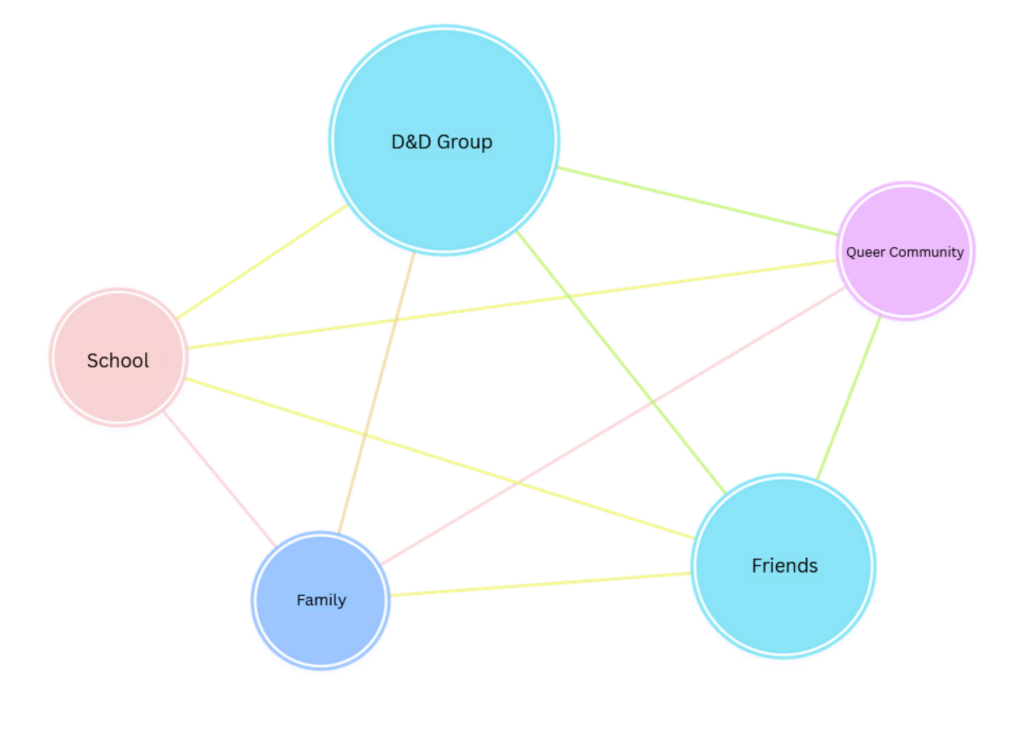
We asked 305 current D&D players from the online Dungeons & Dragons Aotearoa NZ community to complete two tasks. Firstly, they answered an online survey about their demographics, mental wellbeing, loneliness, and self-esteem. Lastly, they made a “mind map” of all their different social groups and answered some questions based on how much time they spent with them, their compatibility with their other social groups (i.e., how well they got along), and how much they felt that each group was important, positive, supportive, and representative of themselves. Each map already had at least one “D&D Group” for people to answer questions about. In doing so, we could take a snapshot of the unique social lives of D&D players, and see whether they found their D&D groups meaningful and whether this had any relationships with their wellbeing.
What Did We Find?
We found that D&D groups were highly important, positive, supportive, and representative to a similar level to friend and family groups. This was despite the fact that our participants spent less time with their D&D groups per month on average compared to their friends and family. D&D groups were also highly-compatible with their other social groups.
The more they felt that their D&D group was positive, supportive, and representative, the more they felt a sense of belonging towards their D&D group. Furthermore, belonging to a D&D group was associated with mental wellbeing and overall feelings of belonging. The more they felt as though they were included in and related to their D&D group, the higher their mental wellbeing and sense of belonging.
Taken together, our findings suggest that TTRPGs could be both meaningful and beneficial for health, supporting mental wellbeing and fostering a sense of belonging.
Now What?
This creates a foundation for further exploration of TTRPGs as a social intervention to address loneliness in the community. We could run TTRPGs in schools as an after-school program or a club, or provide opportunities to play in local community centres and public libraries. A great benefit is that the TTRPGs aren’t clinical; they don’t require specialised personnel to administer. Furthermore, TTRPGs have a devoted community with an abundance of free-to-use resources that can be found online, often for free! In this way, TTRPGs could be used as a cost-effective, engaging, fun, and accessible way to meet people, make new friendships, and combat loneliness in our communities.
Notably, our sample was highly diverse. Almost 17% of our 305 participants identified as being transgender or gender-diverse, despite not explicitly recruiting from rainbow community groups. This speaks to the accessibility and inclusivity of TTRPGs, which hints that TTRPGs could be a way to organically engage communities that more clinical social interventions find traditionally harder-to-reach.
But naturally, there is always more that can be done! After all, our study looked at current TTRPG players; we still need to see whether beginner players experienced the same benefits. Since launching this study, I have worked alongside UC Student Care to interview students who played in their D&D and Daggerheart games about their experience. In early 2026, I ran an experiment where some UC first-years played in a D&D campaign over Term 1 and others did not, so I could compare how playing affected their wellbeing, belonging to the university and fellow students, and academic engagement. I’m currently working on writing up the findings for both of those (so that’s definitely a watch this space if you’re interested).
I’m in the last legs of my PhD, but I hope to continue researching TTRPGs in my future career as an academic. I still have many more questions, and I feel like TTRPGs hold many avenues to explore. I’d like to run TTRPG games for the community outside of university. I want to investigate whether playing TTRPGs in high school impacts phone and social media use. I want to explore everything from the impact of emotional bleed, the possible psychosocial differences between in-person and online games, the differences between different TTRPGs, whether different “GM’ing styles” lead to different outcomes, and what makes a “good” game.
The point is, I am far from running out of ideas to research, and I am excited to continue studying TTRPGs and working with our amazing community. I’ve levelled up, rolled my new hit points, increased my proficiency bonus, and I eagerly await the quest ahead!